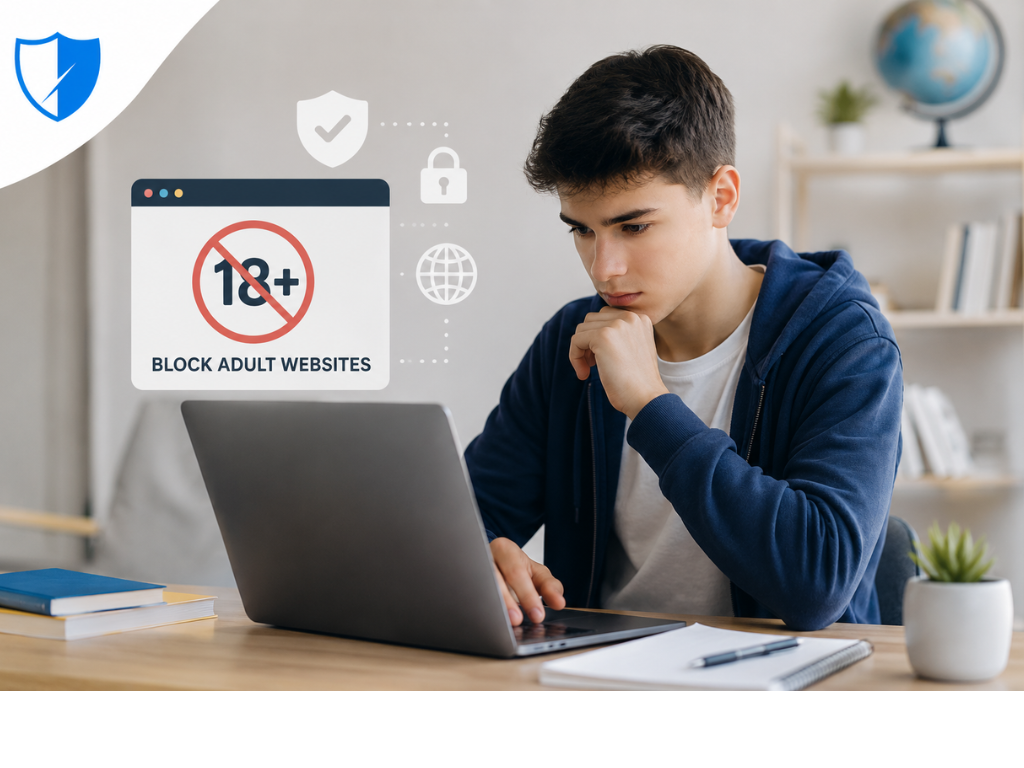
The Problem: Why Students Need Adult Website Blockers
You’re a student trying to research for a term paper. You open your browser, type in a search query, and scroll through results. Within seconds, you’re distracted by social media notifications, YouTube recommendations, and—most alarmingly—explicit content that appears unexpectedly in search results or pop-up ads.
For students, this exposure is more than just uncomfortable. Research from Common Sense Media shows that 47% of parents feel their child is “addicted” to their mobile devices, and 62% of parents whose children watch YouTube say their kids have seen inappropriate videos on the site . Students who use adult website blockers report better concentration, fewer distractions, and improved academic outcomes.
If you’re looking for the best adult website blocker for students, you’re not alone. Millions of parents, teachers, and students search for effective solutions every month. The good news is you don’t need expensive software or an IT professional. Powerful, completely free solutions work instantly and require minimal technical knowledge.
Why students are particularly vulnerable to online distractions
How the right blocker can improve academic focus
Comparison of the top solutions for students
Detailed reviews with pros, cons, and best use cases
How to choose the right tool for different age groups
School-grade enterprise solutions for educators
Why Students Need Protection: Key Statistics
Understanding the scale of the problem helps explain why blocking adult content matters:
Statistic
Source
47% of parents feel their child is “addicted” to mobile devices
Common Sense Media
62% of kids have seen inappropriate videos on YouTube
Common Sense Media
50% of parents are concerned about mobile device impact on mental health
Common Sense Media
89% of parents say primary responsibility for limiting screen time rests with them
Common Sense Media
37% of parents have not used YouTube’s parental controls
Common Sense Media
How We Tested These Tools
Our team evaluated each tool using a standardized methodology:
Criteria
What We Tested
Detection Accuracy
Effectiveness blocking known adult sites and catching new ones
False Positives
Whether legitimate educational sites were incorrectly blocked
Incognito Protection
Whether protection remains active in private browsing
SafeSearch Enforcement
Whether SafeSearch is automatically enabled and locked
Platform Support
Availability across Chrome, Android, iOS, Windows, Mac
Privacy Policy
What data is collected, stored, and shared
Ease of Setup
Installation time and configuration complexity
Our Team: This guide was researched by digital safety experts with experience in cybersecurity, digital addiction recovery, and parental controls. All recommendations are based on independent research.
Comparison Table: Top 8 Adult Website Blockers for Students
Feature
BlockGuard
Web Filter
BlockNSFW
Focus Sessions
Covenant Eyes
Canopy
SPIN Safe Browser
CleanBrowsing
AI Analysis
✅ Yes
❌ No
✅ Smart
❌ No
❌ Post-fact
✅ On-device
❌ No
❌ DNS-level
Real-Time Blocking
✅ Yes
✅ Yes
✅ Yes
✅ Yes
❌ Post-fact
✅ Yes
✅ Yes
✅ DNS-level
Smart YouTube Filter
✅ Restricted
✅ Restricted
❌ No
❌ No
✅ Restricted
❌ No
✅ Yes
❌ No
Incognito Protection
✅ Yes
✅ Yes
✅ Yes
✅ Yes
✅ Yes
✅ Yes
✅ No incognito
✅ Network
Password Protection
✅ Yes
✅ Premium
❌ No
✅ Yes
✅ Yes
✅ Yes
✅ MDM
✅ Yes
Cross-Platform
✅ Chrome, Android, Desktop
✅ Chrome
✅ Chrome, Firefox
✅ Mac
✅ Android, iPhone, Mac, Windows
✅ Android, iPhone, Mac, Windows
✅ iOS, iPadOS
✅ All DNS
CIPA Compliance
❌ No
❌ No
❌ No
❌ No
❌ No
❌ No
✅ Yes
✅ Yes
Free Version
✅ Yes
✅ Yes
✅ Yes
✅ Trial
❌ No
❌ Trial
❌ No
❌ School plan
Best For
Individual Students
Schools/Orgs
Open-Source
Mac Users
Accountability
AI Smart Shield
iOS/MDM Schools
DNS Filtering
Detailed Reviews: Top Solutions
1. BlockGuard: Best Free Student Protection
Overview
BlockGuard is the highest-rated free blocker on the Chrome Web Store. It offers complete real-time protection at zero cost, automatically blocking over 3 million adult websites.
How It Works
The extension uses filtering technology to detect and block adult content before it reaches your screen. It continuously analyzes websites, URLs, and keywords to identify explicit material.
Key Features:
Long Sentence Protection — prevents impulsive disabling
Browsing Insights — tracks habits to identify time-wasting sites
Usage Limit Feature — set daily time limits for specific websites
Cross-platform protection — Chrome, Android, and Desktop
Privacy
BlockGuard does not track or log browsing history.
Pros
Cons
✅ Completely free
❌ Primarily Chrome-focused
✅ AI-powered detection
❌ Limited advanced features
✅ SafeSearch enforcement
✅ Incognito protection
✅ Blocks Shorts, Reels, TikTok
✅ Privacy-focused
Best For: Individual students seeking free, comprehensive protection
Platforms: Chrome, Android, Desktop
Pricing: Free forever
2. Web Filter for Chrome: Best for Schools
Overview
Provides comprehensive filtering with automatic adult content blocking and SafeSearch enforcement. Designed for parents, educators, and organizations .
Key Features:
Instant web filtering for pornography and adult content
DNS filtering designed for schools. Trusted by 10,000+ educational institutions worldwide.
How It Works
Filters at DNS level, protecting all devices on a network without installing software.
Key Features:
19+ pre-defined filters
Pornography, malware, proxy/VPN blocking
Academic fraud blocking
Profiles for teachers vs students
Activity monitoring dashboard
Encrypted DNS support
CIPA compliance
Pros
Cons
✅ Network-level filtering
❌ No AI image analysis
✅ CIPA compliant
❌ School plan requires payment
✅ 19+ filters
✅ Minimal IT overhead
Best For: Schools wanting network-level DNS filtering
Platforms: All devices (DNS-based)
Pricing: Starting at $300/year
Who Should Use Which Tool
If You Are
Best Tool
Why
Student (Individual)
BlockGuard
Free, AI-powered, 3M+ sites blocked
Firefox User
BlockNSFW
Open-source, multi-layer protection
Mac User
Focus Sessions
Cannot be disabled, 400,000+ domains
Parent
CleanBrowsing Family
DNS-level protection for all devices
Teacher
Web Filter for Chrome
Easy deployment, SafeSearch enforcement
School (K-12)
Web Filter or CleanBrowsing
Enterprise features, CIPA compliance
School (iOS/MDM)
SPIN Safe Browser
MDM integration, no private browsing
Expert Recommendations
“Using safe cyber practices on home and personal devices protects you and your family from cyber threats. Taking small steps every day to secure your devices can help prevent attacks like identity theft and malware.” — CISA
“Parental controls can support you in your efforts to keep your kids’ internet experiences safe, fun, and productive. They work best when used openly and honestly in partnership with your kids.” — Common Sense Media
“BlockNSFW is a powerful yet lightweight browser extension designed to keep your browsing safe, distraction-free, and family-friendly. It automatically blocks pornographic and adult websites before they load.” — Firefox Add-ons
“If you just want to limit what your kids can search for, your best option is to enable Google SafeSearch in whichever browser or browsers you use.” — Common Sense Media
Common Mistakes When Choosing a Student Blocker
Relying only on SafeSearch. SafeSearch only filters search results. You need a dedicated blocker that blocks adult websites directly .
Choosing tools without incognito protection. Many blockers don’t work in private browsing. Always verify incognito protection is enabled.
Ignoring app-level blocking. Adult content appears in social media apps, not just browsers.
Forgetting cross-platform coverage. Protection should follow students across devices.
Not checking privacy policies. Cloud-based solutions may upload content for analysis. Choose on-device AI for maximum privacy.
Frequently Asked Questions
What is the best adult website blocker for students?
BlockGuard offers comprehensive free protection with AI filtering and 3+ million sites blocked. For schools, Web Filter for Chrome and CleanBrowsing provide enterprise-level solutions.
Can I block adult websites on Chrome for my child?
Yes. Use BlockGuard extension for immediate protection, Google Family Link for activity management, and DNS filtering for network-wide coverage .
What’s the best open-source adult website blocker?
BlockNSFW is open-source with MIT license, offering multi-layer protection including domain blocking and keyword filtering .
Is there a free adult website blocker for students?
Yes. BlockGuard offers comprehensive free protection. BlockNSFW is open-source and free .
What are the best school-grade web filtering solutions?
Web Filter for Chrome — Extension-based filtering for Chromebooks
CleanBrowsing — DNS filtering starting at $300/year
SPIN Safe Browser — iOS/MDM deployment
How do schools block adult content on Chromebooks?
Schools use extension-based filtering like Web Filter for Chrome which automatically blocks adult content and enforces SafeSearch .
Can students bypass adult website blockers?
Tech-savvy students may find workarounds. The most effective approach combines multiple layers: extension + DNS filtering + router settings + open conversations .
What is CIPA compliance?
The Children’s Internet Protection Act requires schools to block obscene content. Schools can achieve compliance with solutions like Web Filter for Chrome and CleanBrowsing .
Conclusion: Protect Students and Enhance Focus
The best adult website blocker for students depends on your specific needs:
For individual students seeking free protection, BlockGuard offers comprehensive AI filtering with 3+ million sites blocked, SafeSearch enforcement, and incognito protection—all at no cost.
For open-source transparency, BlockNSFW offers multi-layer protection with MIT license .
For K-12 schools, Web Filter for Chrome provides easy Chromebook deployment with automatic adult content blocking , and CleanBrowsing offers affordable DNS filtering.
You’re browsing a seemingly safe website. A pop-up appears. You click to close it, but instead, explicit images flood your screen. This happens because traditional content blockers only check against static lists of known adult domains—they don’t analyze what’s actually on the page.Which Software Blocks Adult Content in Real Time
Real-time adult content blocking software solves this problem by analyzing content as it loads, before it reaches your screen. This distinction is critical for modern internet users. AI-based filtering can detect explicit visual content much faster than traditional blacklist-only systems.
How real-time adult content blocking actually works
Comparison of 9 top AI-powered blockers
Detailed reviews with pros, cons, and best use cases
How to choose the right software for your needs
Expert recommendations and common mistakes
Final verdict with scoring table
Why Traditional Porn Blockers Fail in 2026
Traditional porn blockers rely on static lists of known adult website URLs. This approach was reasonably effective in the early 2000s when the internet was smaller and adult content was concentrated on dedicated websites.
Here’s why they fail today:
New Sites Appear Daily — Thousands of new domains are registered every day, including countless adult websites. Static lists can’t keep up. By the time a new adult site is added to a blocklist, many people may have already been exposed to it.
Adult Content is Everywhere — Explicit content no longer appears only on adult domains. It shows up on social media platforms, image search results, video thumbnails, and disguised within otherwise legitimate pages. Traditional blockers only check domain names, not page content.
Disguised Content — Many adult sites use URL shorteners, redirects, or deliberately misleading domain names to avoid detection. Traditional blockers can’t identify these because they only check against known domains.
No Image Analysis — Static lists only look at website addresses. They can’t detect explicit images or videos appearing on YouTube, Reddit, Instagram, or other platforms. This is a massive blind spot since most users now encounter explicit content on social media, not dedicated adult sites.
Easy Bypass Methods — Users can often disable traditional blockers in seconds through incognito mode, VPNs, or simply uninstalling the extension. Without tamper-protection features, these blockers provide a false sense of security.
No Real-Time Analysis — Traditional blockers decide whether to block a site based solely on its URL. They don’t analyze what’s actually on the page. This means a page can contain explicit images but still load because its domain isn’t on the list.
How Real-Time Adult Content Blocking Works
The Technology Behind Real-Time Blocking
Understanding the technology helps you make informed decisions about which software blocks adult content effectively.
AI Image Classification
Modern adult content blockers use artificial intelligence to analyze every image before it appears on your screen. These machine learning models identify nudity, sexually explicit poses, and other unsafe visual patterns in milliseconds. Because the analysis happens while the webpage loads, users never see explicit content even if it appears on a completely new website. Some tools use WebGPU acceleration for fast on-device classification, while others like FocusShield use local AI models with no data uploads.
On-Device vs Cloud-Based Processing
Processing Type
Advantages
Considerations
On-Device AI
Complete privacy, no data uploaded, works offline
Limited by device processing power
Cloud-Based AI
More powerful models, faster analysis
Privacy concerns, requires internet
How AI Detection Works
AI models are trained on millions of images to recognize patterns associated with explicit content. The training process involves showing the AI system thousands of examples of both explicit and non-explicit images, allowing it to learn the visual patterns that distinguish them. Models like MobileNet v2 (2.6MB, fast) and InceptionV3 (22MB, highly accurate) are used for real-time classification directly in your browser.
Text and Keyword Analysis
Intelligent keyword detection identifies sexually explicit text, discussions, and links across browsers, apps, and social media feeds. This analysis happens in real-time, scanning page content as it loads. Solutions like FocusShield combine this with visual analysis for comprehensive protection.
Blur-First Approach
Suspicious content is blurred immediately, then cleared only if classification confirms it’s safe. You never see a flash of explicit content. This is a critical user experience feature because even a split-second exposure can be triggering for someone in recovery.
Domain-Level and DNS Blocking
Known adult sites are filtered instantly before any content loads, creating a first line of defense. Some solutions also offer optional DNS-based blocking through Cloudflare for Families.
Comparison Table: Top Real-Time Adult Content Blocking Software
Feature
BlockGuard
FocusShield
NSFW Filter
BlockNSFW
Content Safety Lock
Canopy
Covenant Eyes
AI Parental Control
Bulldog Blocker
AI Image Analysis
✅ Yes
✅ On-device
✅ On-device
✅ Yes
❌ No
✅ On-device
❌ Post-fact
✅ Cloud
✅ On-device
Real-Time Blocking
✅ Yes
✅ Yes
✅ Yes
✅ Yes
✅ Yes
✅ Yes
❌ Post-fact
✅ Yes
✅ Yes
Image Blurring
✅ Yes
✅ Yes
✅ Yes
❌ No
❌ No
✅ Yes
❌ No
❌ No
❌ No
Text Analysis
✅ Yes
✅ Yes
❌ No
✅ Yes
❌ No
✅ Yes
❌ No
✅ Yes
✅ Yes
Incognito Protection
✅ Yes
✅ Yes
✅ Yes
✅ Yes
✅ Yes
✅ Yes
✅ Yes
✅ Yes
✅ Yes
SafeSearch Lock
✅ Yes
✅ Yes
❌ No
✅ Yes
✅ Yes
✅ Yes
✅ Yes
❌ No
✅ Yes
On-Device Privacy
✅ Yes
✅ Yes
✅ Yes
✅ Yes
✅ Yes
✅ Yes
❌ No
❌ No
✅ Yes
Cross-Platform
✅ Chrome, Android, Desktop
✅ Chrome
✅ Chrome
✅ Chrome, Firefox
✅ Firefox
✅ Android, iPhone, Mac, Windows
✅ Android, iPhone, Mac, Windows
✅ Chrome
✅ Android
Free Version
✅ Yes
✅ Yes
✅ Yes
✅ Yes
✅ Yes
✅ Trial
❌ No
✅ Demo
✅ Yes
Pricing
Free Forever
Free
Free
Free
Free
$95-$120/year
$184/year
$1.99/mo Pro
Free/Premium
Detailed Reviews: Top Real-Time Adult Content Blocking Software
1. BlockGuard: Best Completely Free Real-Time Blocker
Overview
BlockGuard is the highest-rated free porn blocker on the Chrome Web Store, with over 15,000 active users. Unlike “free” tools that hide basic features behind paywalls, BlockGuard offers complete real-time protection at zero cost.
How It Works
BlockGuard uses AI-powered filtering technology to detect and block adult content before it reaches your screen. The system continuously analyzes websites, URLs, keywords, and other content signals to identify explicit material. When adult content is detected, BlockGuard automatically prevents access.
What BlockGuard Blocks:
Over 3 million adult websites automatically
Explicit content through AI-powered real-time detection
Search results with SafeSearch enforcement
Incognito mode to prevent bypass
YouTube Shorts, Instagram Reels, and TikTok
Custom keywords and websites through personalized blocklists
Key Features:
Long Sentence Protection — Prevents impulsive disabling by requiring you to type a custom sentence
Browsing Insights — Tracks browsing habits to identify time-wasting websites
Usage Limit Feature — Set daily time limits for specific websites
Privacy
BlockGuard does not track or log your browsing history. All filtering happens locally without sending data to external servers.
Best For: Individuals seeking completely free comprehensive protection, families on a budget, students needing distraction blocking
2. FocusShield: Best On-Device Privacy-Focused Blocker
Overview
FocusShield is an AI-powered porn blocker that automatically detects and blurs sexually explicit and suggestive content as you browse. All image classification runs entirely on your device with zero images uploaded.
How It Works
FocusShield uses a multi-layer approach:
Domain-level blocking — known adult sites are filtered instantly
AI image classification — on-device machine learning analyzes images in real-time
Text analysis — intelligent keyword detection identifies sexually explicit content
Blur-first approach — suspicious content is blurred immediately, then cleared only if safe
Privacy
All image classification runs entirely on your device. Zero images are ever uploaded or transmitted anywhere. No browsing history is collected, stored, or shared.
Configurable Strictness:
Strict — aggressively blurs anything remotely suggestive, designed for recovery
Balanced — reasonable middle ground
Relaxed — only blurs unambiguously pornographic content
Best For: Privacy-conscious users, people in recovery, professionals working in shared spaces
Platforms: Chrome only
Pricing: Free
3. NSFW Filter: Best GPU-Accelerated AI Blocker
Overview
NSFW Filter uses WebGPU acceleration for fast on-device image classification, blocking explicit content in real-time.
How It Works
The extension automatically scans all images on web pages using TensorFlow.js and NSFWJS neural networks via WebGPU. Content is classified into 5 categories: Drawing, Hentai, Neutral, Porn, and Sexy.
Key Features:
Model Selection — MobileNet v2 (2.6MB, fast) or InceptionV3 (22MB, maximum accuracy)
Adjustable Sensitivity — Flexible slider from 0% to 100% strictness
100% Local Processing — All images analyzed only on your computer
GPU Acceleration — WebGPU for maximum classification speed
LRU Cache — 500 entries for instant repeated checks
Best For: Users wanting GPU-accelerated AI filtering, those who need adjustable strictness
Platforms: Chrome only
Pricing: Free
4. BlockNSFW: Best Open-Source Multi-Layer Blocker
Overview
BlockNSFW is an open-source browser extension that combines multiple detection methods for stronger protection. Already used by thousands of users.
How It Works
BlockNSFW combines several protection layers:
Domain blocking with local fallback rules plus remote blocklist updates
Hostname smart filter with multilingual adult-keyword coverage
Page and visible-content filtering through Manifest V3 content script
Search SafeSearch enforcement on Google, Bing, DuckDuckGo, and more
Optional DNS-based blocking through Cloudflare for Families
Reddit NSFW subreddit checks
Optional Facebook Reels and Instagram Reels blocking toggles
Local stats, streak tracking, whitelist management
Best For: Users wanting open-source transparency, multi-layer protection
Platforms: Chrome, Firefox, Microsoft Edge
Pricing: Free (MIT License)
5. Content Safety Lock: Best for Self-Lock Commitment
Overview
Content Safety Lock takes a unique approach by trusting publisher labels rather than cloud blocklists. It uses voluntary content labels like RTA, ICRA/SafeSurf ratings, and HTML meta tags.
How It Works
Instead of a centrally maintained blocklist, Content Safety Lock reads signals directly from the page:
RTA label (RTA-5042-1996-1400-1577-RTA) — most widely deployed voluntary adult content signal
ICRA / SafeSurf PICS ratings — structured ratings for sexual content, violence, profanity
HTML meta tags — rating=adult, rating=mature, rating=restricted
7. Covenant Eyes: Best Accountability-Based System
Overview
Covenant Eyes focuses on “screen monitoring and reporting” rather than real-time blocking. It captures screenshots and sends them to an accountability partner.
How It Works:
Takes random screenshots of the user’s screen across devices
Uses AI to analyze screenshots for explicit screen activities
Flags suggestive material as “Highlighted Activity” or “Explicit Screenshots”
Pros:
Strong accountability system
The “Ally” system for accountability partners
Web blocking with two levels
Cons:
Very expensive ($184/year)
Not real-time blocking (post-fact only)
Inaccurate AI detection in testing
Screenshots often blurry
Hard to cancel subscription
Best For: Individuals with accountability partners, those needing external motivation
Platforms: Android, iPhone, Mac, Windows
Pricing: $18/month ($184/year)
8. AI Parental Control: Best OpenAI-Powered Blocker
Overview
AI Parental Control leverages OpenAI’s advanced moderation technology to analyze and block inappropriate web content in real-time. Unlike traditional tools relying on static blacklists, this extension scans each page as it loads.
Key Features:
Customizable filters to block explicit material, violence, and hate speech
Real-time AI filtering using OpenAI technology
Password protection
Block history with Pro plan
Multi-language support (English and Spanish)
Privacy
No browsing data is saved or stored.
Pricing:
Demo — 25 page analyses per day, free
Pro ($1.99/mo or $14.99/yr) — Unlimited analyses, block history
Best For: Families wanting OpenAI-powered content moderation
Platforms: Chrome only
9. Bulldog Blocker: Best System-Wide Android Blocker
Overview
Bulldog Blocker uses AI to scan your screen for porn across your entire device, not just the browser.
How It Works:
Constantly scans your screen for porn using AI
Works across your entire device, not just browser
Blocks by quickly hitting back button or home button when porn detected
When porn repeatedly seen, locks offending app for 15 minutes
Works on mixed-content sites like Instagram, X
Privacy: Extreme privacy — Bulldog doesn’t transfer any screen data off the device.
Features:
Optional blocking of immodest swimsuits, exercise clothing
PIN protection, timed delay, or remote friend permission
Very low battery usage — about 1% per day
App blocking and whitelist features
Best For: Android users wanting system-wide protection
Platforms: Android only
Pricing: Free/Premium
How We Evaluated These Software
To ensure accurate, trustworthy recommendations, we evaluated each software based on:
Evaluation Criteria
What We Tested
AI Detection Accuracy
Effectiveness detecting known adult sites and catching newly created ones
Privacy
What data is collected, stored, and shared
Platform Support
Availability across Chrome, Android, iOS, Windows, Mac
Price
What’s free versus paid, and whether free version is actually useful
Ease of Use
Setup time, intuitive design, and user experience
Update Frequency
How often blocking lists and AI models are updated
User Reviews
Real user experiences and satisfaction ratings
Security
Protection against bypass methods (incognito, VPN, uninstall)
Our Team: This guide was researched by digital safety experts with backgrounds in cybersecurity, digital addiction recovery, parental controls, and software testing.
Comparison Scoring Table
Software
AI Detection
Privacy
Platform Support
Price
Ease of Use
Overall Score
BlockGuard
9.7
9.6
9.5
10
9.8
9.7
FocusShield
9.5
10
7.0
9.5
9.5
9.1
NSFW Filter
9.5
10
7.0
10
9.0
9.1
BlockNSFW
9.0
9.5
8.5
10
9.0
9.2
Content Safety Lock
8.0
10
6.0
10
8.0
8.4
Canopy
8.8
9.0
9.5
7.0
8.5
8.6
Covenant Eyes
7.0
8.0
9.5
5.0
7.0
7.3
AI Parental Control
9.5
9.0
7.0
8.5
9.0
8.6
Bulldog Blocker
9.0
9.5
6.0
8.5
8.0
8.2
Comparison Verdict Table: Which Software Is Best For You?
Need
Best Choice
Why
Free Protection
BlockGuard
Completely free with AI filtering, 3M+ sites blocked, no credit card
Privacy Focus
FocusShield
On-device AI with zero image uploads, no data collection
GPU-Accelerated AI
NSFW Filter
WebGPU acceleration, adjustable sensitivity
Open-Source
BlockNSFW
MIT license, transparent code, community-driven
Self-Control Tools
Content Safety Lock
Self-Lock feature, commitment tools
Parents with Kids
Canopy
AI filtering with app blocking, screen time limits
System-Wide Android
Bulldog Blocker
Screen scanning across all apps, not just browser
Accountability
Covenant Eyes
Screenshot-based reporting for accountability partners
Expert Recommendations
“Real-time AI filtering is the most effective approach for blocking adult content because it catches explicit material wherever it appears—not just on known adult sites. Solutions with on-device AI like FocusShield and BlockGuard analyze content as it loads, preventing exposure before it happens.”
“On-device AI processing is the privacy gold standard. When content analysis happens locally, no images or browsing data are ever uploaded, giving users complete control over their information.”
“Self-Lock features like those in Content Safety Lock and Long Sentence Protection in BlockGuard create the mental gap between urge and action that willpower alone can’t provide.”
“The blur-first approach is a game-changer for user experience. By blurring suspicious content immediately and only clearing it when confirmed safe, users are never exposed to explicit material—even momentarily.”
Common Mistakes When Choosing Content Blocking Software
Relying only on SafeSearch. SafeSearch only filters search results. Real-time blockers block adult websites directly.
Choosing tools without incognito protection. Many blockers don’t work in private browsing. Always verify incognito protection is enabled.
Ignoring app-level blocking. Adult content appears in social media apps, not just browsers. Choose software that blocks across all apps.
Forgetting cross-platform coverage. Protection should follow you across devices—Android, iOS, Windows, Mac.
Choosing only accountability without blocking. Accountability tools report activity but don’t prevent real-time exposure. Combine with real-time blockers.
Not checking privacy policies. Cloud-based solutions may upload content for analysis. Choose on-device AI tools for maximum privacy.
Frequently Asked Questions
Which software blocks adult content in real time?
BlockGuard, FocusShield, NSFW Filter, and BlockNSFW all block adult content in real-time. The best choice depends on your specific needs—free protection, privacy, or cross-platform support.
How does real-time adult content blocking work?
Real-time blockers use AI to analyze images, text, and video content as it loads. Suspicious content is either blocked or blurred immediately before it reaches your screen.
What’s the difference between real-time and traditional blocking?
Traditional blockers rely on static lists of known adult domains. Real-time blockers use AI to analyze content dynamically, catching newly created sites and explicit images on social media that blocklists miss.
Can real-time blockers work in incognito mode?
Yes. Most real-time blockers can be enabled to work in incognito mode. Go to chrome://extensions, find your blocker, click “Details,” and toggle “Allow in incognito.”
Are real-time blockers privacy-safe?
It depends. On-device AI tools like FocusShield, NSFW Filter, and BlockGuard process everything locally—no images or browsing history are transmitted. Cloud-based tools may upload content for analysis.
Can real-time blockers block social media content?
Yes. Advanced real-time blockers like FocusShield and BlockGuard detect explicit content on YouTube, Reddit, Instagram, and other social media apps.
What’s the best free real-time adult content blocker?
BlockGuard offers the most comprehensive free real-time protection with AI filtering, 3+ million sites blocked, and no credit card required. FocusShield offers excellent free on-device privacy protection.
What’s the most privacy-focused real-time blocker?
FocusShield processes all image classification entirely on your device with zero images uploaded. NSFW Filter also offers 100% local processing.
Does Chrome block NSFW websites by default?
No. Google Chrome’s built-in Safe Browsing protects against malware and phishing but does not block adult content. You need a dedicated extension.
Can VPN bypass porn blockers?
Yes, VPNs can bypass some porn blockers. DNS-based filters and router-level blocking are more effective against VPN bypass.
Which browser has the best adult content protection?
Chrome with an extension like BlockGuard or FocusShield provides comprehensive protection. Firefox users can use BlockNSFW or Content Safety Lock.
Conclusion: Take Control of Your Digital Life
Understanding which software blocks adult content in real time is essential for online safety and digital wellbeing. Traditional domain-based blockers are no longer sufficient in a world where explicit content appears everywhere—social media, search results, video thumbnails, and disguised web pages.
Real-time AI-powered solutions like BlockGuard, FocusShield, and NSFW Filter analyze content as it loads, blocking or blurring explicit material before it reaches your screen. On-device processing provides complete privacy with no data uploaded or stored.
For those seeking completely free protection, BlockGuard offers comprehensive AI filtering with over 3 million sites blocked, SafeSearch enforcement, incognito protection, and Long Sentence Protection—all at no cost.
For those whose highest priority is privacy, FocusShield processes all image classification entirely on your device with zero images uploaded. NSFW Filter also offers 100% local processing with GPU acceleration.
For open-source transparency, BlockNSFW offers multi-layer protection with MIT license and community-driven development.
For those with accountability partners, Covenant Eyes provides detailed screenshot-based reporting but is expensive ($184/year) and does not provide real-time blocking.
For system-wide Android protection, Bulldog Blocker scans across all apps, not just the browser.
Your Next Steps:
Choose Your Solution
BlockGuardfor comprehensive free protection across platforms
FocusShield for privacy-focused Chrome-only protection with blurring
NSFW Filter for GPU-accelerated on-device AI
Enable Incognito Protection
Go to chrome://extensions, find your blocker, click “Details,” toggle “Allow in incognito”
Test Your Protection
Confirm real-time blocking works across apps and browsers
The Problem: Why Your Chrome Browser Needs Protection
You’re searching for something simple—a recipe for dinner, a news article about current events, or a study resource for an important exam. You type a few words into the search bar, hit enter, and scroll through the results. Everything seems normal. Then, without warning, you click on what looks like a legitimate link. Within milliseconds, your screen is flooded with explicit, inappropriate content that you never intended to see.
This scenario plays out millions of times every single day across the globe. Parents helping children with homework suddenly scramble to close inappropriate pop-ups. Students researching school projects accidentally stumble upon adult websites disguised as educational resources. Professionals taking quick breaks between meetings are bombarded with explicit advertisements appearing out of nowhere.
According to research, the average age of first exposure to online pornography is now just 11 years old. Children still in elementary school, still developing their understanding of the world, are being exposed to content their developing brains simply cannot process. This early exposure has lasting effects on mental health, relationships, and understanding of healthy sexuality.
Once exposed, many people struggle to regain control. The brain’s reward system, designed to reinforce beneficial behaviors, can be hijacked by the intense dopamine release pornography triggers. Over time, this leads to compulsive viewing habits that interfere with work, relationships, and overall quality of life. Learning how to block porn on Chrome free is not just about avoiding embarrassment—it’s about protecting mental health and digital wellbeing.
If you’re wondering how to block porn on Chrome free, you’re not alone. Millions search for effective adult content blockers every month. The good news is you don’t need expensive software or an IT professional. Powerful, completely free solutions work instantly and require minimal technical knowledge.
What You’ll Learn in This Guide
Why most porn blockers fail and what to look for instead
7 free methods to block adult content on Chrome
Why people search for “how to block porn on Chrome free”
Whether Chrome can block adult websites without extensions
Signs your current porn blocker isn’t working
Common mistakes while blocking adult content
Detailed comparison of top free extensions
How to choose the right tool for parents, students, or personal use
Step-by-step setup instructions for complete protection
Common myths debunked with evidence
Why People Search “How to Block Porn on Chrome Free”
Understanding why people search for this topic helps you choose the right solution. Different users have different needs:
Parents are the largest group. They need to protect children from inappropriate content. According to child safety organizations, parents should combine device restrictions, network-level filtering, and app-based protection for real-time AI filtering to create comprehensive coverage . Children are naturally curious, and the internet is a vast, unregulated space where they can easily stumble upon content they’re not ready to process.
Students need to eliminate distractions. With the pressure of exams, assignments, and deadlines, students can’t afford to lose hours of productive time to compulsive browsing. A porn blocker helps them stay on track and achieve their academic goals.
Office users need to maintain productivity at work. In many workplaces, accessing adult content can lead to disciplinary action or even termination. Beyond professional consequences, it simply reduces efficiency and lowers work quality.
Individuals recovering from compulsive habits need tools that support their recovery. Breaking any addiction is difficult, but when the addictive substance is available 24/7 on a device you carry in your pocket, it becomes even harder. A porn blocker provides a crucial safety net that prevents relapse during moments of weakness.
Schools and educational institutions need to protect students during school hours. This requires solutions that work across multiple devices and are difficult for students to bypass.
Shared computer users need protection when multiple people use the same device. This is common in libraries, internet cafes, and family homes where children and adults share the same computer.
Can Chrome Block Adult Websites Without Extensions?
No. Chrome cannot block adult websites without extensions.
Google Chrome is the world’s most popular web browser, with over 3 billion active users. Its security features protect against malware and phishing, but they have a significant blind spot: no adult content filtering.
Chrome’s Safe Browsing feature is excellent at identifying dangerous websites that contain malware or attempt to steal personal information. But it does not flag or block websites simply because they contain adult content. This means that even with all of Chrome’s security features enabled, users can still access adult websites freely.
What Chrome’s Built-In Tools Can’t Do:
Block adult websites typed directly into the address bar
Prevent access through incognito or private browsing mode
Filter explicit content on social media platforms
Stop accidental exposure through advertisements or pop-ups
Protect against newly created adult sites not on any blocklist
This is why you need a dedicated porn blocker. A comprehensive Chrome extension works in real-time, analyzing websites before they load and blocking explicit content instantly.
Google SafeSearch only filters explicit content from search results. When enabled, it prevents adult images, videos, and text from appearing in search results. However, SafeSearch can be easily turned off unless locked, and it does not block adult websites accessed directly through typed URLs or bookmarks .
How Porn Blockers Work: A Technical Overview
Before diving into specific solutions, it’s helpful to understand how content filtering actually works. This knowledge helps you make informed decisions about which approach suits your needs.
Blacklist-Based Blocking
The simplest method uses a list of known adult website URLs. When you try to visit a site on this list, the blocker prevents access. This is how early porn blockers worked.
Strengths: Fast, simple, minimal system resources Weaknesses: Misses newly created sites, requires constant updates, can be bypassed easily
Keyword and Content Analysis
More advanced blockers scan page titles, meta descriptions, and visible content for explicit keywords. Some also analyze image content using basic pattern recognition.
Strengths: Catches some new sites, doesn’t rely solely on lists Weaknesses: Can produce false positives, struggles with images, easily tricked
AI-Powered Real-Time Filtering
The most advanced approach uses machine learning to analyze content as it loads. AI models are trained on millions of examples to recognize explicit content, even when it’s disguised or embedded in otherwise legitimate pages. According to digital wellness experts, real-time AI filtering steps in exactly when you’re about to slip, keeping you focused and on track.
Strengths: Catches newly created sites, handles disguised content, reduces false positives Weaknesses: Requires more processing power, more complex to implement
DNS-Level Filtering
This method works at the network level. When your device requests a website, the DNS server checks if the domain is on a blocklist before translating it to an IP address. CleanBrowsing and OpenDNS are popular free options.
Strengths: Protects all devices on network, no software installation needed Works on: All devices connected to the network including smart TVs Weaknesses: Only works on configured network, doesn’t protect mobile data, can be bypassed
Router-Level Blocking
Similar to DNS filtering but configured directly on your router. Some router brands like Gryphon, Netgear, and TP-Link have built-in parental control features with pre-configured settings to limit adult sites .
Strengths: Protects every device connected to Wi-Fi Weaknesses: Can be bypassed with cellular data, requires router configuration
How Chrome Extensions Fit In
Browser extensions combine multiple techniques:
They check URLs against updated blocklists
They analyze page content using keyword detection
Advanced extensions use AI for real-time analysis
They enforce SafeSearch settings
They provide incognito protection
Signs Your Current Porn Blocker Isn’t Working
If you already have a porn blocker installed but are still encountering issues, here are signs it may not be effective:
Incognito bypass: If adult sites load in incognito mode, your blocker isn’t fully protecting you. A quality blocker should work in private browsing.
Doesn’t block new sites: If newly created adult sites load, your blocker relies on static lists without AI filtering.
Doesn’t block images: If explicit images appear even when text is filtered, your blocker lacks image analysis capability.
Doesn’t stop Shorts or Reels: If you can still access addictive short-form video content, your blocker doesn’t address social media distractions.
Easy uninstall: If you can disable or remove the blocker in seconds without a password, it’s not providing real protection.
No SafeSearch enforcement: If SafeSearch can be turned off, your blocker isn’t locking it.
No incognito protection: If your blocker doesn’t work in private browsing, users can simply switch to incognito to bypass protection.
No notification: If blocked attempts go unnoticed, you’re missing accountability.
Common Mistakes While Blocking Adult Content
Avoid these common pitfalls to ensure effective protection:
Only using SafeSearch. SafeSearch only filters search results, not adult websites accessed directly. A comprehensive porn blocker blocks adult websites directly and enforces SafeSearch everywhere.
Only using DNS filtering. DNS filtering only works on configured networks and can be bypassed with VPNs or mobile data. It should be combined with other methods.
No password or sentence protection. Without locking settings, users can disable the blocker in moments of weakness.
Ignoring incognito mode. Users can bypass many blockers by switching to private browsing. Always enable incognito protection.
Not updating extensions. Outdated extensions miss newly created adult sites.
No router filtering. Network-level protection covers all devices on your Wi-Fi, including smart TVs and game consoles.
Parents sharing passwords. If children know the password, they can disable protection.
Using only one method. No single method is 100% effective. Layering creates robust protection.
Not testing protection. Always test that adult sites are actually blocked.
Forgetting mobile devices. Many users protect desktop but forget phones, which are often the primary internet device.
7 Free Ways to Block Porn on Chrome
Now that we’ve explored why people search for these solutions and common mistakes, let’s examine the most effective free methods available in 2026.
Method 1: Install a Free Chrome Extension
This is the most effective and easiest way to block porn on Chrome. Browser extensions work directly inside Chrome, filtering content in real-time as you browse. Unlike DNS filters requiring router configuration, extensions provide immediate protection with just a few clicks.
A good Chrome extension actively analyzes content, enforces SafeSearch settings, and prevents bypassing through private browsing modes. This makes them ideal for both personal use and family protection.
Top Free Extensions Compared:
Feature
BlockGuard
Porn Blocker
Safe Browse
SafeBrowse Parent Control
Sites Blocked
3M+
Growing list
Built-in list
Built-in + custom
AI Filtering
✅ Yes
❌ No
❌ No
❌ No
SafeSearch Lock
✅ Yes
❌ No
❌ No
✅ Yes
Incognito Protection
✅ Yes
✅ Yes
❌ No
✅ Yes
Custom Blocklist
✅ Yes
❌ No
✅ Yes
✅ Yes
Password/Sentence Protection
✅ Yes
❌ No
❌ No
✅ Yes
Parent/Child Profiles
❌ No
❌ No
❌ No
✅ Yes
Block Shorts/Reels
✅ Yes
❌ No
❌ No
❌ No
Privacy Focused
✅ Yes
✅ Yes
✅ Yes
✅ Yes
Free Forever
✅ Yes
✅ Yes
✅ Yes
✅ Yes
Android App
✅ Yes
❌ No
❌ No
❌ No
Desktop App
✅ Yes
❌ No
❌ No
❌ No
Understanding Your Options:
BlockGuard is the highest-rated free porn blocker on the Chrome Web Store with over 15,000 active users. It combines AI-powered filtering with SafeSearch enforcement and incognito protection. Key features include blocking over 3 million adult websites, custom blocklist and whitelist, Long Sentence Protection to prevent impulsive disabling, and the ability to block Shorts, Reels, and TikTok. It’s available as a Chrome extension, Android app, and desktop application.
BlockGuard includes unique Long Sentence Protection that sets it apart from other free options. When you try to disable BlockGuard, you must type a custom sentence you previously set. This creates a mental gap between urge and action—exactly what you need in moments of weakness .
Porn Blocker by Relay Health offers real-time filtering and redirects to a help page when adult content is detected. With over 60,000 users, it’s lightweight (111KB) and privacy-focused with no data collection.
Safe Browse focuses on privacy with custom rules, import/export lists, and local processing. It never stores browsing information.
SafeBrowse Parent Control is designed for families with features including parent/child profiles, image blurring, word filtering, activity reports, and PIN protection.
Method 2: Enable and Lock SafeSearch
SafeSearch filters explicit content from Google search results. When enabled, it prevents adult images, videos, and text from appearing in search results. However, SafeSearch can be easily turned off unless locked .
Under “SafeSearch filters,” select “Turn on SafeSearch”
Click “Save”
How to Lock SafeSearch:
After enabling, click “Lock SafeSearch” at bottom
Sign in to your Google account
Follow prompts to confirm locking
Once locked, SafeSearch cannot be changed without account password
Important Considerations:
Locking SafeSearch requires a Google account. For children’s devices, create a supervised account through Google Family Link. SafeSearch only works on Google search results—it does not block adult websites accessed directly through typed URLs or bookmarks. This is why SafeSearch should be combined with a dedicated extension like BlockGuard for complete protection.
Method 3: Use Google Family Link
Google Family Link provides comprehensive parental controls beyond SafeSearch. It gives detailed visibility into children’s device usage and tools to set appropriate boundaries .
Key Features:
Manage screen time and device usage with daily limits
Approve or block apps and websites before installation
View activity reports showing which apps are used and for how long
Lock SafeSearch permanently so it cannot be disabled
Manage multiple children’s devices from a single dashboard
Set bedtimes that lock devices during specified hours
Locate child’s device with GPS tracking (with permission)
How to Set Up:
Download Google Family Link on parent and child devices
Open app on parent device and follow setup wizard
Create supervised accounts for each child
Configure content restrictions for Chrome
Set daily screen time limits and bedtimes
Review activity reports regularly
Family Link operates at system level, making it harder for children to bypass than browser extensions. However, it cannot block adult content on unflagged websites—another reason to combine with BlockGuard.
Method 4: Set Up DNS Filtering
DNS filtering blocks adult content at network level. When configured on your router, it protects every device connected to your Wi-Fi—all Chrome browsers, smartphones, tablets, even smart TVs .
Free DNS Filtering Services:
Service
DNS Addresses
Features
OpenDNS Family Shield
208.67.222.222, 208.67.220.220
Blocks adult content, free, no installation, works on all devices
CleanBrowsing Family Filter
185.228.168.168, 185.228.169.169
Blocks adult content and mixed content, free, family-friendly
CleanBrowsing Adult Filter
185.228.168.10, 185.228.169.11
Blocks adult content only, allows mixed content
How to Configure:
Open router settings (usually 192.168.1.1)
Log in (often “admin”/”admin”)
Find DNS settings under Internet/WAN settings
Replace existing DNS with family-friendly addresses
Save and restart router
Advantages: Protects all devices, no software installation, works on devices without extensions, free . Disadvantages: Only works on home Wi-Fi, not mobile data, can be bypassed by tech-savvy users, may occasionally block legitimate content.
Method 5: Enable Chrome’s Built-In Safe Browsing
Chrome’s Safe Browsing protects against dangerous websites, malware, and phishing attacks. While not targeting adult content specifically, it protects against security risks accompanying adult websites.
Method 6: Use Extension Password or Sentence Protection
Many free porn blockers allow locking settings to prevent disabling. This is particularly important for parents and individuals who want to prevent impulsive disabling during moments of weakness.
How It Works: Settings lock behind a password or custom sentence. To change settings, disable blocking, or uninstall, user must enter the password or type the sentence.
Why Sentence Protection Works Better: Typing a full sentence takes several seconds longer than entering a short password. This creates a mental gap between urge and action—exactly what you need in moments of weakness.
Method 7: Combine Multiple Methods
For strongest protection, use combination approach. No single method is 100% effective, but layering creates robust protection difficult to bypass.
Recommended Combinations:
User Type
Recommended Combination
Parents
Chrome extension + Family Link + DNS filtering + SafeSearch lock
How to Choose the Right Porn Blocker for Your Needs
For Parents Protecting Children
The best adult content blocker for parents depends on your child’s age and device usage :
Key Features to Prioritize:
AI-powered filtering to catch new adult sites
SafeSearch enforcement and locking
Incognito mode protection
Custom blocklist for specific concerns
Password/sentence protection to prevent disabling
Recommended Approach: Start with a Chrome extension for immediate blocking, add Family Link for activity monitoring and screen time management, and configure DNS filtering on your router for network-wide protection . This creates multiple layers that are difficult for children to bypass.
For Students and Professionals
Students and professionals need to maintain focus while protecting against distractions:
Key Features to Prioritize:
Lightweight extension that doesn’t slow browsing
Real-time filtering that works automatically
Distraction blocking for Shorts, Reels, and social media
Quick setup with minimal configuration
Recommended Approach: A Chrome extension with automatic filtering is usually sufficient. Look for one that offers comprehensive protection at no cost and runs efficiently in the background.
For Individuals Overcoming Compulsive Habits
Those serious about breaking compulsive browsing habits need tools with accountability and tamper-resistance:
Key Features to Prioritize:
Uninstall prevention or hard-to-disable protection
Accountability features or partner notifications
Focus mode to reduce overall screen time
Progress tracking and habit monitoring
Recommended Approach: Sentence protection prevents impulsive disabling. Combine with habit tracking and community support for best results .
Step-by-Step Setup Guide
Option 1: Using BlockGuard (Recommended for Most Users)
Step 1: Install the Extension
Open Chrome and go to the Chrome Web Store
Search for “BlockGuard” or use the direct link
Click “Add to Chrome”
Review the permissions requested and click “Add extension”
The BlockGuard icon will appear in your toolbar
Step 2: Enable Adult Content Blocking
Click the BlockGuard icon in your toolbar
Toggle on “Adult Content Blocking”
The extension will immediately begin blocking adult sites
Step 3: Customize Your Protection
Click the BlockGuard icon again
Select “Settings” from the dropdown
Add websites to your blocklist or whitelist
Enable SafeSearch enforcement
Configure Long Sentence Protection by setting a custom sentence
Step 4: Enable Incognito Protection
Go to chrome://extensions in your Chrome browser
Find BlockGuard in the list of extensions
Click “Details”
Toggle “Allow in incognito” to enable protection during private browsing
Step 5: Test Your Protection
Try visiting a known adult site to confirm blocking works
You should see a blocked page or redirect
If blocking doesn’t work, check that the extension is enabled
Option 2: Using BlockGuard with Android Protection
For complete cross-device protection:
Open Google Play Store on your Android device
Search for “BlockGuard”
Install the BlockGuard Android app
Grant necessary permissions (Accessibility and VPN)
Enable adult content blocking and distraction-blocking features
Option 3: Using DNS Filtering for Network Protection
Configure CleanBrowsing DNS on your router or individual devices
Test that adult sites are blocked across all devices
Expert-Backed Recommendations
Content filtering experts and child safety organizations consistently recommend a layered approach to online protection. Here are evidence-based recommendations:
“The most effective digital protection strategy combines multiple layers: browser extensions for immediate blocking, network-level DNS filtering for all devices, and built-in tools like SafeSearch for search results.” — Based on guidelines from child safety organizations
“Willpower alone is not sufficient for breaking compulsive browsing habits. Environmental design—removing temptation through blockers and filters—is more effective than relying on self-control in moments of weakness.” — Based on behavioral psychology research on addiction prevention
“When choosing a content filter, prioritize tools that work in incognito mode and include tamper-protection. The most common bypass methods are private browsing and disabling protection.” — Based on analysis of user behavior patterns
“Parents should be involved in their children’s digital lives beyond just installing filters. Open conversations about online safety combined with appropriate technical controls create the strongest protection.” — Based on recommendations from child development experts
Common Myths and Concerns
“Free porn blockers don’t work.”
False. Free solutions like BlockGuard, Porn Blocker, and SafeBrowse offer professional-grade protection at no cost . The key is choosing an extension with real-time filtering and a comprehensive blocklist. Free doesn’t mean low-quality—many free extensions are developed by dedicated teams committed to accessible online safety.
“I can just use SafeSearch.”
False. SafeSearch only filters search results. It does not block adult websites accessed directly through typed URLs or bookmarks . A comprehensive porn blocker blocks adult websites directly and enforces SafeSearch everywhere, providing protection that SafeSearch alone cannot offer.
“Incognito mode bypasses everything.”
False. Good blockers work in incognito mode, preventing private browsing from being a loophole .
“Blockers slow down my browser.”
False. Modern porn blockers are lightweight and optimized for performance. Most extensions run efficiently in the background without significantly impacting browsing speed.
“Tech-savvy users can bypass anything.”
Partially True. No blocker is 100% foolproof against someone with enough time and technical knowledge. The goal is removing easy, impulsive access—not creating an impenetrable fortress. Password protection, incognito blocking, and sentence protection significantly raise the effort required.
“I don’t need a blocker because I have good self-control.”
False. Willpower is a limited resource that tires with overuse. When stressed, tired, or emotionally overwhelmed, self-control is weakest. Having a porn blocker ensures protection even in vulnerable moments .
Frequently Asked Questions
How do I block porn on Chrome free?
The easiest way is installing a free Chrome extension like BlockGuard. It automatically blocks adult websites, enforces SafeSearch, and provides incognito protection—all at no cost.
What is the best free porn blocker for Chrome?
BlockGuard is the highest-rated free porn blocker on the Chrome Web Store. It offers AI-powered filtering, 3+ million blocked sites, SafeSearch enforcement, and Long Sentence Protection to prevent impulsive disabling.
Can I block adult content in incognito mode?
Yes. Most porn blockers can be enabled to work in incognito mode. Go to chrome://extensions, find your blocker, click “Details,” and toggle “Allow in incognito.”
How does Long Sentence Protection work?
When you try to disable BlockGuard, you must type a custom sentence you previously set. This creates a time buffer that allows rational thinking to overcome impulsive urges.
Does Google have a built-in porn blocker?
No. Google SafeSearch filters search results only. You need a dedicated extension for complete protection.
Can I block adult sites on Chrome for my child?
Yes. Use a combination approach: Chrome extension for immediate protection, Family Link for activity management, and DNS filtering for network-wide coverage .
What’s the best approach for parents?
Combine multiple layers: Chrome extension + Family Link + DNS filtering on router + SafeSearch lock . This creates comprehensive protection across all devices.
Will a porn blocker affect my browsing speed?
Modern blockers are lightweight and optimized for performance. Most run efficiently without slowing down browsing.
Can I whitelist certain sites?
Yes. BlockGuard and most other blockers allow whitelisting specific sites while maintaining protection for others.
What happens when a blocked site is attempted?
BlockGuard blocks the page and shows a notification. You can customize redirects or motivational messages.
Conclusion: Take Control of Your Chrome Browsing
Learning how to block porn on Chrome free is one of the most important steps for online safety and digital wellbeing. The tools are available, and the best ones don’t cost a penny. Whether you’re protecting children, eliminating distractions, or building healthier habits, a reliable porn blocker is your first line of defense.
The most effective approach combines multiple layers: browser extensions for immediate blocking, DNS filtering for network-wide coverage, and built-in tools like SafeSearch for search results. Installing a free Chrome extension takes less than a minute but provides lasting protection.
Your Next Steps:
Install a Free Chrome Extension for immediate protection
Enable SafeSearch and lock it
Set Up Password or Sentence Protection to prevent impulse disabling
Enable Incognito Protection (chrome://extensions)
Test Your Protection (confirm adult sites blocked)
Consider Additional Layers (DNS filtering, Family Link, time limits)
The Problem: Why Your Digital Habits Are Harming Your Mental Health
You check your phone first thing in the morning. You scroll through social media during work breaks. You watch videos late into the night. And somewhere in between, you might accidentally—or intentionally—stumble upon content that leaves you feeling drained, distracted, or ashamed.
If this sounds familiar, you’re not alone. In 2024, the Oxford English Dictionary named “brain rot” its word of the year, defining it as “the supposed deterioration of a person’s mental or intellectual state” caused by overconsumption of trivial online content . The term actually dates back to 1854, when Henry David Thoreau wrote: “While England endeavours to cure the potato rot, will not any endeavour to cure the brain-rot—which prevails so much more widely and fatally” .
Today, with 5.45 billion internet users worldwide, the problem has only intensified . Research shows that in 2004, people spent an average of 150 seconds on a task before switching focus. By 2022, that number had plummeted to just 47 seconds. The constant connectivity that technology provides comes at a steep cost: digital addiction, anxiety, depression, diminished sleep quality, and fractured relationships .
But there is hope. A growing movement is helping people build healthier digital habits—and the best porn blocker is often the first and most effective tool in this journey.
What You’ll Learn in This Guide:
What digital wellbeing really means and why it matters
How explicit content affects your brain and mental health
7 proven strategies to build healthier digital habits
How the best adult content blocker fits into your digital wellness plan
Step-by-step guidance for protecting your family online
What Is Digital Wellbeing?
Digital wellbeing is a comprehensive framework that encompasses the attitudes, behaviors, practices, and strategies needed for balanced and conscientious technology use . It recognizes that while technology offers incredible benefits—access to information, connection with loved ones, productivity tools—it also poses serious risks when used without intention .
According to the Mental Health Commission of Canada, digital wellbeing isn’t about quitting technology cold turkey. Instead, it’s about designing your digital diet based on your life context to find a sustainable balance . Think of it like nutrition: you don’t eliminate all food, but you make conscious choices about what you consume.
The Four Pillars of Digital Wellbeing
1. Mindful Technology Use This means being conscious of how, when, and why you use digital devices . Are you reaching for your phone out of boredom, anxiety, or genuine need? Mindfulness creates the mental gap between urge and action, allowing you to make better choices .
2. Mental and Physical Health Excessive screen time is linked to anxiety, depression, stress, eye strain, poor posture, and disrupted sleep . The best porn blocker helps protect your mental health by reducing exposure to content that triggers compulsive behavior.
3. Work-Life Balance Technology blurs the boundaries between work and personal life, often leading to burnout and chronic stress . Setting boundaries—like no devices in the bedroom or scheduled offline hours—is essential for recovery .
4. Healthy Online Interactions Social media can foster connection but also fuels unhealthy behaviors like social comparison, cyberbullying, and online harassment . A reliable adult content blocker helps filter out harmful content, creating a cleaner digital environment.
How Explicit Content Impacts Your Brain
Understanding the neuroscience of porn addiction helps explain why thebest porn blocker is so essential for building healthier digital habits.
Dopamine Overload Pornographic content triggers an intense dopamine reward in the brain. Over time, your brain becomes tolerant to this dopamine, requiring more extreme content to achieve the same high. This is the same mechanism that drives addiction to drugs, gambling, and sugar.
Compulsive Behavior As your brain’s reward pathways get rewired, you start experiencing cravings for porn even when you don’t want to watch it. You feel helpless against the habit loop, and real-life relationships, work, and friendships begin to take a backseat.
Withdrawal Symptoms When you try to quit, you may experience anxiety, depression, irritability, and intense cravings. This is why willpower alone rarely works—you need a system that removes the temptation entirely.
The Solution: A Porn Blocker That Actually Works The best adult content blocker interrupts this cycle by removing easy access to porn. Instead of relying on willpower in moments of weakness, you create a digital environment where the choice is already made for you.
7 Proven Strategies to Build Healthier Digital Habits
Strategy 1: Install a Powerful Porn Blocker
This is the most important step for anyone serious about building healthier digital habits. The best porn blocker removes the option before you’re tested, making the right choice the path of least resistance .
What to Look For in a Porn Blocker:
AI-powered filtering that catches new adult sites that static blocklists miss
SafeSearch enforcement to filter explicit search results
Incognito mode protection to prevent bypassing
Uninstall prevention and password protection
Cross-platform support for all your devices
Distraction blocking for Shorts, Reels, and TikTok
Recommended Solution: BlockGuard offers completely free, AI-powered protection with all these features and more.
One of the most effective ways to build healthier digital habits is establishing clear boundaries around technology use .
What Experts Recommend:
No devices at the dinner table—this creates space for meaningful family conversation
No devices in the bedroom—this improves sleep quality and intimacy
Unplug at least one hour before bed—blue light disrupts melatonin production
Set do-not-disturb times on your devices
Use Airplane Mode to mute all notifications during focused work
Real-Life Example: One colleague stopped using their phone for basic functions because “once you pick it up, it becomes a vortex of notifications.” They replaced their phone with an alarm clock, a calculator, and a flashlight .
Strategy 3: Practice the “Sunshine Before Screen Time” Rule
Starting your day with screen-free activities sets a positive tone for the rest of your day .
Ideas for Morning Routines:
Go for a walk or exercise
Read a physical book
Journal with pen and paper
Meditate or practice mindfulness
Have breakfast without devices
Why It Works: Morning screen use triggers the dopamine cycle before your brain has had a chance to wake up naturally. By delaying your first screen interaction, you regain control over your attention.
Strategy 4: Replace Screen Time with Analog Activities
The antidote to digital overload is physical-world engagement .
Screen-Free Hobbies to Try:
Walking the dog—”whatever the weather”
Gardening—one person said they “can disappear for hours in the garden, and it feels like minutes”
Reading physical books—”curl up with a good book and a hot cup of tea”
Handcrafting—making miniatures, painting, or pottery
Board games and crossword puzzles—with the help of a dictionary
Yoga and meditation—”being present in every moment on the mat brings unexpected insights”
The Science: When you engage in flow-state activities (where you’re fully immersed and lose track of time), you experience the same dopamine release—but without the addiction risk .
Strategy 5: Use Accountability and Consequences
Creating external accountability dramatically increases your chances of success .
Proven Accountability Techniques:
Financial penalties: One professor struggled with procrastination, so he and a colleague agreed that if they didn’t stick to their writing schedule, they’d donate money to a cause they disliked
Group rules: A friend group has a rule—the first person who checks their phone at dinner pays for drinks
Accountability partners: Share your goals with someone you trust and ask them to check in regularly
No Social November (NoSo): This grassroots challenge encourages students to take a month-long break from social media
Why It Works: External consequences activate the brain’s reward system differently than internal motivation. You’re more likely to follow through when others are involved.
Strategy 6: Practice “Unhashing” Your Life
There’s a campaign in Vienna called “Unhashtag Vienna” that encourages tourists to enjoy the city without constantly documenting it .
How to Apply This to Your Life:
Leave your phone at home when running errands
Take photos only for yourself, not for social media
Enjoy moments without the lens of a smartphone camera
Practice “presence without the extra knowledge”—just enjoy the TV show without Googling every detail about the characters
The Benefit: When you stop documenting everything, you start actually experiencing it. This builds presence, reduces anxiety, and deepens your relationships.
Strategy 7: Talk About Digital Habits as a Family
The American Academy of Pediatrics emphasizes that building healthier digital habits is a family activity, not just an individual one .
Conversation Starters for Families:
“What do you like about social media platforms?”
“How do you feel when you’re on social media?”
“Have you seen anything concerning online?”
“What’s real and what’s edited or fake?”
“How does media affect your emotions?”
Set a Good Example: When your attention is on your device, tell your kids what you’re doing. Be kind to others online and talk about how you’re using media for good .
Create a Family Media Plan: Work together to set rules about social media use so everyone agrees on how devices fit into your lives .
How a Porn Blocker Supports All These Strategies
You might wonder: “How does a porn blocker help me build healthier digital habits?” Here’s how:
It removes temptation so you don’t have to rely on willpower alone
It blocks distractions like adult content and addictive short-form videos
It creates friction around impulsive behavior, giving you time to make better choices
It protects your family from accidental exposure to harmful content
It supports focus by reducing digital clutter
The best adult content blocker doesn’t just block porn—it creates an environment where healthier digital habits can flourish.
Comparison: Top Porn Blocker Features That Support Digital Wellbeing
Feature
Why It Matters
BlockGuard
AI-Powered Filtering
Catches new adult sites static lists miss
✅ Yes
SafeSearch Enforcement
Filters explicit search results
✅ Yes
Incognito Protection
Prevents private mode bypass
✅ Yes
Uninstall Prevention
Stops impulsive disabling
✅ Yes
Password Protection
Secures settings from tampering
✅ Yes
Block Shorts/Reels
Reduces addictive scrolling
✅ Yes
Free Forever
Accessible to everyone
✅ Yes
Expert Recommendations for Building Healthier Digital Habits
“Small, consistent actions—not willpower alone—create lasting change. A porn blocker removes the option before you’re tested, making the right choice the path of least resistance.”
“In 2024, people spent an average of 47 seconds on a task before switching. To reclaim your attention, start with screen-free mornings and scheduled offline time.”
“Digital wellbeing isn’t about quitting technology—it’s about designing your digital diet based on your life context.”
Frequently Asked Questions
What is the best porn blocker for building healthier digital habits?
The best adult content blocker combines AI-powered filtering, SafeSearch enforcement, incognito protection, and uninstall prevention. BlockGuard offers all these features completely free.
How does a porn blocker help with digital addiction?
By removing easy access to triggers, a porn blocker breaks the habit loop. Instead of relying on willpower, you create an environment where healthier choices are automatic.
Can I block porn on Chrome for free?
Yes. BlockGuard offers a completely free Chrome extension that blocks adult websites, enforces SafeSearch, and prevents bypassing through incognito mode.
What’s the difference between a porn blocker and SafeSearch?
SafeSearch only filters search results. A porn blocker blocks adult websites directly, enforces SafeSearch, filters explicit images, and prevents access through private browsing modes.
How can I protect my children from online adult content?
Use a combination approach: a reliable adult content blocker like BlockGuard, Google Family Link for activity management, OpenDNS for network-level protection, and open family conversations about online safety .
Does using a porn blocker slow down my browser?
No. Modern porn blockers like BlockGuard are lightweight and optimized for performance. They run efficiently in the background without impacting browsing speed.
Conclusion: Your Journey to Healthier Digital Habits Starts Today
Building healthier digital habits isn’t about perfection—it’s about progress. It’s about making small, consistent choices that add up to lasting change.
The best porn blocker is an essential tool in this journey. It removes temptation, creates friction around impulsive behavior, and protects your family from harmful content. But it works best when combined with the other strategies in this guide: screen-free times, analog activities, accountability, and open family conversations.
Your Next Steps:
Install a powerful porn blocker on all your devices
Create screen-free times and places in your home
Practice “sunshine before screen time” in your morning routine
Replace screen time with flow-state analog activities
The question “can AI filter explicit images online” has become one of the most pressing concerns for internet users in 2026. With billions of images uploaded daily across social media platforms, dating apps, e-commerce sites, and educational websites, manual content moderation simply cannot keep pace with the volume of user-generated content. The sheer scale of digital content creation has made human-only moderation not just impractical but impossible for most organizations.
Modern artificial intelligence has revolutionized content moderation, offering real-time detection and blocking of nudity, sexually explicit material, graphic violence, and other inappropriate visual content. But how does this technology actually work? Can it be trusted to protect children, students, and families from harmful online material? And what are its limitations? These are questions that millions of parents, educators, and concerned individuals ask daily as they navigate an increasingly complex digital landscape.
The answer, as we’ll explore throughout this comprehensive guide, is both encouraging and nuanced. AI has made remarkable strides in content filtering, but it’s not a silver bullet. Understanding how the technology works, its strengths and weaknesses, and how to implement it effectively is essential for anyone serious about digital safety in 2026 and beyond.
What Is AI Content Filtering?
AI content filtering refers to the use of machine learning models and computer vision technologies to automatically analyze digital content and determine whether it violates predefined safety standards. Unlike traditional keyword-based or blocklist-dependent filters, AI systems evaluate the actual visual content of images, videos, and text to make informed decisions. This fundamental shift in approach means AI can detect explicit content even when filenames, metadata, or text descriptions attempt to hide its nature.
The technology works by training deep learning models on massive datasets containing millions of labeled images. These neural networks learn to recognize patterns associated with explicit content—nudity, sexual activity, suggestive imagery, and even subtle visual cues that might indicate harmful material. The training process is intensive and requires vast computing resources, but the result is a system that can make sophisticated judgments about content in milliseconds.
When you upload an image or visit a website, AI systems scan the content in real time, assign confidence scores based on detected attributes, and either approve, flag for manual review, or block the content entirely. This happens in milliseconds, far faster than any human reviewer could manage. For platforms handling millions of uploads daily, this speed is not just convenient—it’s essential for maintaining a safe environment for users.
The sophistication of modern AI content filtering extends to its ability to handle context. For instance, an AI system can distinguish between a medical textbook image showing anatomical details and pornographic content, even if both contain similar visual elements. This contextual awareness is achieved through training that teaches the AI to recognize not just what’s in an image, but the broader context in which it appears—accompanying text, source website, and even the user’s search history can all be considered.
Can AI Filter Explicit Images Online Effectively?
Yes. Modern AI can filter explicit images online with a high degree of accuracy. However, the effectiveness depends on several factors, including the quality of the training data, the sophistication of the model architecture, and how regularly the system is updated. Leading AI filters achieve accuracy rates above 95% on standard benchmarks, with some specialized models reaching 99% or higher in controlled testing environments.
However, real-world performance can vary. A model that performs exceptionally well on a standard dataset might struggle with content from different cultural contexts or with adversarial images designed to fool AI systems. This is why continuous improvement and regular updates are essential for maintaining high effectiveness. The most successful implementations combine AI with human oversight, regular model updates, and user feedback loops to catch and correct errors.
It’s also important to understand that “filtering” encompasses different levels of intervention. Some systems simply block access to explicit content entirely. Others might blur images, display warning messages, or flag content for human review. The appropriate level of intervention depends on the context—what’s appropriate for a children’s educational platform may differ from what’s suitable for a social media site with adult users.
How AI Detects Explicit Images
Computer Vision Technology: AI interprets images similarly to how humans recognize visual patterns—examining shapes, colors, textures, and objects within an image. This foundational technology allows the AI to “see” what’s in a picture rather than just reading its filename or metadata. Over the years, computer vision has evolved from simple edge detection to complex feature extraction that can identify subtle patterns and relationships between different elements in an image.
Deep Learning Models: Advanced neural networks are trained on millions of labeled images, learning to distinguish safe content from explicit material. The deep learning process involves multiple layers of analysis, with each layer extracting increasingly abstract features from the image. The first layer might detect edges and colors, the second layer might recognize shapes and patterns, and deeper layers might identify specific objects or even understand the overall scene. This hierarchical learning approach is what gives deep learning models their remarkable accuracy.
Content Classification: After analysis, AI categorizes images into predefined groups: Safe, Sensitive, Adult, Explicit, or Restricted. Some systems achieve up to 100% accuracy on test datasets, though real-world performance varies. The classification process is typically done in real-time, allowing the AI to make decisions within milliseconds. The categories themselves can be customized based on the needs of the user or organization, making AI content filtering highly adaptable to various contexts and requirements.
Context Awareness: Modern AI goes beyond simple nudity detection. It evaluates context—for instance, distinguishing between educational medical images and adult content—to reduce false positives. This contextual understanding is achieved through sophisticated training that teaches the AI to recognize not just what’s in an image, but the broader context in which it appears. Factors like accompanying text, the source website, and even the user’s search history can all be considered. This represents a significant advancement over earlier systems that relied solely on visual analysis.
Why AI Content Filtering Matters
User Protection
Maintaining a safe environment for all users is essential, especially for platforms aiming to be child-friendly. AI filters block explicit content before users—particularly minors—are exposed to harmful material. The psychological impact of accidental exposure to explicit content can be significant, especially for children and teenagers whose brains are still developing. AI filtering provides a crucial protective barrier that helps prevent these negative experiences.
Brand Safety
Organizations protect their reputation from users posting inappropriate content. A single explicit image shared publicly can damage trust and credibility. For businesses, this can translate directly into lost revenue and customer trust. AI filtering helps prevent such incidents by catching inappropriate content before it goes public, protecting brands from reputational damage.
Legal Compliance
Content regulation requirements are strict in many regions, particularly the EU. AI moderation helps platforms meet these obligations without overwhelming manual review teams. Compliance isn’t just about avoiding fines—it’s about demonstrating responsibility and building trust with users who expect platforms to maintain safe environments.
User Experience
Most users prefer not to encounter gore, nudity, or explicit material while browsing. AI filters enhance overall satisfaction by creating a cleaner, more predictable online environment. This improved user experience can lead to increased engagement, longer session times, and higher user retention rates.
Scalability
Manual moderation cannot keep up with the volume of user-generated content. AI systems scale effortlessly, analyzing thousands of images per second without requiring proportional increases in human resources. This scalability makes AI not just faster but also more cost-effective than human moderation at scale.
Protection Against Emerging Threats
As AI-generated explicit content becomes more sophisticated and widespread, AI-powered detection systems are increasingly essential. These systems can identify synthetic content that might be indistinguishable to the human eye, helping platforms stay ahead of new threats. This proactive approach is crucial in the ongoing battle against harmful content online.
The Benefits of AI-Powered Content Moderation
Benefit
Impact
Faster Detection
AI analyzes thousands of images within seconds, far outperforming human review
Scalability
Systems scale without requiring large moderation teams
Consistent Enforcement
AI follows predefined rules uniformly across all content
Enhanced User Safety
Effective filtering protects users, especially minors, from unwanted exposure
Reduced Operational Costs
Automation lowers the costs associated with large-scale content review
24/7 Availability
AI systems work continuously without fatigue or bias
Adaptability
Models can be fine-tuned for specific use cases and cultural contexts
The Technology Behind Modern AI Filters
The Training Process
Training an AI to filter explicit images is a resource-intensive process that requires three key elements: massive datasets, powerful computing infrastructure, and sophisticated algorithms.
Dataset Preparation: The first step involves collecting millions of images, each labeled by human reviewers as “safe” or “explicit.” This dataset must be diverse enough to represent the full range of content the AI might encounter in the real world. It should include images from different cultures, lighting conditions, resolutions, and contexts. The quality and diversity of the training data directly impact the model’s performance.
Model Architecture: The neural network architecture defines how the AI processes visual information. Modern systems use Convolutional Neural Networks (CNNs) specifically designed for image analysis. These networks consist of multiple layers, each extracting different features from the image. Early layers detect basic features like edges and colors, while deeper layers recognize complex patterns and objects.
Training Process: During training, the AI processes images from the dataset and compares its predictions against the human-provided labels. When it makes an error, it adjusts its internal parameters to reduce future errors. This process repeats millions of times until the model achieves acceptable accuracy. Training a state-of-the-art model can take weeks on specialized hardware like Graphics Processing Units (GPUs) or Tensor Processing Units (TPUs).
Validation and Testing: Before deployment, the model is tested on images it has never seen before. This validation process ensures the model generalizes well to new content rather than simply memorizing the training data. Models that perform well on validation data are then fine-tuned for specific use cases and deployed in production.
Real-World Implementation
Once trained, AI filters are deployed in various ways:
Real-time analysis: The AI scans images as they’re uploaded, making decisions in milliseconds
Batch processing: Existing content libraries are screened for violations
Hybrid approaches: AI flags suspicious content for human review, combining speed with accuracy
Leading platforms use a combination of these approaches, adapting their filtering strategy based on the specific use case and risk profile.
Limitations of AI Image Filtering
While AI has advanced significantly, it is not perfect. Understanding these limitations helps set realistic expectations and design better protection strategies.
False Positives (Safe Content Blocked)
Safe content may occasionally be flagged incorrectly. For example, users have reported AI blockers incorrectly flagging YouTube videos featuring lens and phone reviews. These false positives can be frustrating but are typically resolved through whitelisting features. False positives are particularly problematic in educational contexts, where legitimate medical or artistic content might be incorrectly blocked.
False Negatives (Explicit Content Missed)
Some explicit content may bypass filters, particularly newly created or modified images that the AI hasn’t been trained on. New forms of explicit content are constantly emerging, and AI systems need regular updates to keep pace. Sophisticated attackers also deliberately design content to evade detection, creating an ongoing arms race.
Cultural Differences
Definitions of acceptable content vary across regions and industries, making universal moderation challenging. What’s considered explicit in one culture might be acceptable in another. A model trained primarily on Western content might not accurately judge content from other cultural contexts. Similarly, different organizations have different policies about what content is allowed.
Adversarial Attacks
Content creators constantly develop methods to evade detection, requiring AI systems to update regularly. “Adversarial samples”—images designed to fool AI—can exploit blind spots in models. These attacks can be as simple as adding subtle noise to an image that confuses the AI while being invisible to the human eye, or as complex as generating completely fake images designed specifically to bypass filters.
Continuous Adaptation
Because of these challenges, the most effective systems combine AI automation with human oversight and policy management. Regular model updates, user feedback mechanisms, and a willingness to adjust settings are essential for maintaining effective protection.
Types of AI Content Filters
1. Browser Extension Filters
These work directly inside web browsers like Chrome and Microsoft Edge. They use AI to analyze images, block explicit content, enforce Safe Search, and reduce online distractions. Lightweight and easy to install, they are popular for personal use. Browser extensions typically run locally on the user’s device, ensuring privacy while providing real-time protection.
Advantages: Easy installation, real-time protection, privacy-preserving Limitations: Limited to browser activity, may not cover all apps
2. Mobile App Filters
Mobile filters protect users from explicit images across apps and websites on smartphones and tablets. Unlike browser extensions, mobile filters can provide system-wide protection, blocking explicit content in any app. This comprehensive coverage is essential because mobile devices are now the primary internet access point for many people.
Advantages: System-wide protection, covers all apps, works on mobile-optimized content Limitations: Requires app installation, may need accessibility permissions
3. Enterprise and Cloud-Based Filters
These robust systems analyze multiple images per request and provide granular results. Designed for businesses and platforms needing high-volume, reliable content moderation, they often include detailed analytics and reporting. Enterprise solutions can also handle more complex scenarios, such as detecting explicit content in video streams or analyzing images in multiple languages.
Advantages: High-volume processing, detailed analytics, customizable policies Limitations: More complex setup, may require integration with existing systems
4. DNS-Level Filters
These filters block explicit content at the network level, preventing access to adult websites regardless of the device or application being used. They work by maintaining a blacklist of adult domains and preventing connections to them. This approach provides protection across all devices on a network, including smart TVs, gaming consoles, and IoT devices.
Advantages: Network-wide protection, no software installation on individual devices Limitations: Limited to domain-based blocking, may not catch image-level content
How BlockGuard Uses AI to Filter Explicit Images
BlockGuard combines advanced AI technology with user-friendly controls to provide comprehensive online protection. Here’s how it works:
1. Block Explicit Images in Real-Time
BlockGuard uses AI-powered filters to detect nudity, semi-nudity, and adult content on any website you visit. Unlike simple URL blockers, it actively analyzes images to prevent accidental exposure. This real-time protection ensures that even newly created websites or images that haven’t been cataloged in a blocklist can be filtered effectively. The AI works silently in the background, making split-second decisions that protect users without interrupting their browsing experience.
2. Comprehensive Filtering Across the Web
It enforces Safe Search across all major search engines (Google, Bing, DuckDuckGo) and YouTube, filtering explicit images, videos, and search results. You can also add custom websites and keywords for extra protection. This comprehensive approach ensures that users are protected not just on dedicated adult websites, but throughout their entire online experience.
3. Prevent Bypass and Maintain Focus
Features like password protection, Incognito Mode protection, and the ability to block distracting short-form content (YouTube Shorts, TikTok) ensure protection remains active even when temptation strikes. These features make it harder for users to casually disable their protections, providing a crucial layer of accountability that supports long-term digital wellness.
4. System-Wide Protection on Android
BlockGuard for Android blocks adult content across all browsers and apps using VPN-based filtering. This ensures protection even in private browsing modes without routing your data through external servers. The local VPN approach provides comprehensive coverage while maintaining user privacy.
5. A Proven, Free Solution
Trusted by over 15,000 users with a 4.8-star rating on the Chrome Store, BlockGuard provides powerful, enterprise-grade protection at no cost, making digital safety accessible to everyone. This free access is particularly important because cost should never be a barrier to protecting oneself or one’s family from harmful content.
6. Continuous Updates
BlockGuard’s AI models are regularly updated to catch new forms of explicit content and adapt to emerging threats. This commitment to continuous improvement ensures that users always have the most current protection available.
How to Choose the Right AI Filter
When selecting an AI content filter, consider these factors:
Device Compatibility
Ensure the solution works across Windows, Mac, Chrome, Android, and all browsers your household uses. Inconsistent coverage is a common reason filters fail in practice. A filter that only covers a laptop leaves the most-used device in the house completely open.
Automatic Updates
Adult sites change constantly—new domains, new hosting, new tricks to slip past filters. The tool should update its filtering rules and models automatically in the background. This continuous adaptation is essential for maintaining effective protection over time.
Ease of Use
Simple setup and clear controls matter most for families and schools rolling this out to non-technical users. If configuration takes an afternoon and a manual, it’s more likely to be abandoned than maintained.
Layered Filtering
Look for a combination of website filtering, image filtering, SafeSearch enforcement, and AI detection. Relying on just one layer leaves predictable gaps—a website filter alone won’t catch an explicit image embedded on an otherwise unremarkable page.
Performance Impact
A blocker that noticeably slows down browsing tends to get disabled within a week. Real-time filtering should be fast enough to feel invisible during normal use. Modern lightweight extensions have largely resolved the performance issues of older tools.
Tamper Resistance
Features like password protection, uninstall prevention, and Incognito Mode support ensure the filter can’t be casually disabled. This is particularly important for parents protecting children and individuals working on building healthier digital habits.
Cost and Value
Free tiers are worth starting with, but check what’s actually included versus locked behind a paid plan. BlockGuard provides comprehensive protection completely free, making it an ideal choice for individuals and families.
Best Practices for Effective Protection
Use Multiple Protection Layers
Combine AI image analysis, website filtering, and a reliable adult content blocker. No single layer is perfect, but multiple layers working together provide robust protection.
Update Models Regularly
New threats emerge constantly. Regular updates improve detection accuracy. Set your tools to update automatically whenever possible.
Define Clear Policies
Establish content standards that align with your organizational or personal goals. What’s acceptable in one context may not be in another.
Monitor Performance
Review blocked content reports and adjust settings when necessary. Understanding what’s being blocked helps you fine-tune your protection.
Educate Users
Technology works best when users understand safe online behavior and digital responsibility. Education empowers users to make better choices even when filters aren’t present.
Review Settings Periodically
Revisit your filtering settings occasionally, especially after major browser or OS updates, since these can sometimes reset extension permissions.
The Future of AI Content Filtering
The future looks promising for AI-powered moderation systems. Emerging technologies are expected to deliver:
Greater Contextual Understanding
Future AI systems will have an even deeper understanding of context, allowing them to distinguish between appropriate and inappropriate content with greater accuracy. This could mean fewer false positives and a more nuanced approach to content moderation. For example, AI might distinguish between artistic nudity, medical images, and pornographic content more reliably than current systems.
Improved Detection Accuracy
Ongoing research and development will continue to push the boundaries of what AI can detect, leading to higher accuracy rates and fewer missed cases of explicit content. Advances in model architecture and training techniques will contribute to these improvements.
Real-Time Video Moderation
While current systems primarily focus on images, future systems will be able to analyze video content in real-time, detecting explicit scenes as they occur. This would enable platforms to block harmful content in live streams and video uploads more effectively.
Multimodal Content Analysis
AI will become better at analyzing multiple types of content simultaneously, combining text, image, video, and audio analysis for a more complete understanding of content. This multimodal approach will reduce false positives and negatives by considering all available context.
Enhanced Protection Against AI-Generated Explicit Content
As AI becomes more powerful, it can also be used to generate explicit content. Future systems will need to detect AI-generated content and distinguish it from real images. Specialized models are being developed specifically for this purpose.
Federated and Privacy-Preserving Learning
Future systems may use federated learning approaches that train models on user data without that data leaving individual devices. This would improve privacy while still enabling the continuous improvement of AI models.
Real-Time Translation Across Cultures
Future AI filters will be better at understanding cultural differences in what constitutes acceptable content. This would enable more contextually appropriate moderation across different regions and platforms.
Conclusion
So, can AI filter explicit images online? The answer is a clear yes. Modern artificial intelligence has transformed how we protect ourselves and our families from harmful online content. What was once a manual, time-consuming process has evolved into sophisticated systems capable of analyzing billions of images in real-time, making split-second decisions about what content is appropriate and what should be blocked.
However, no AI system is perfect. False positives and false negatives still occur, and malicious actors are constantly developing new ways to bypass filters. This is why the most effective approach combines multiple layers of protection—AI-powered filtering, real-time website blocking, SafeSearch enforcement, and user education.
This is where BlockGuard excels. By combining advanced AI detection with comprehensive filtering features and a user-friendly interface, BlockGuard provides a powerful, free solution for individuals, families, and organizations looking to create safer digital environments. Whether you’re a parent protecting your children, a student trying to stay focused, or a professional maintaining productivity, BlockGuard offers the tools you need to take control of your online experience.
The future of AI content filtering is bright. Emerging technologies promise even greater accuracy, better contextual understanding, and real-time video moderation. As these innovations mature, AI will become an even more indispensable tool for maintaining digital safety and wellness.
Ultimately, the question “can AI filter explicit images online” is no longer just about technical capability—it’s about taking proactive steps to protect yourself and your loved ones in an increasingly complex digital world. By understanding the technology, choosing the right tools, and building healthy online habits, you can create a safer, more focused, and more productive digital environment for yourself and those you care about.
Frequently Asked Questions (FAQs)
1. Can AI filter explicit images online effectively?
Yes, AI can filter explicit images online with a high degree of accuracy. Modern AI systems use advanced computer vision and deep learning models to detect nudity, sexual content, and other inappropriate material in real-time. While no system is perfect, leading solutions like BlockGuard combine multiple filtering layers to achieve strong protection. Some specialized models achieve accuracy rates above 99% in controlled testing, though real-world performance can vary based on content quality and diversity.
2. How does AI filter explicit images online?
AI filters explicit images through a multi-step process. Computer vision analyzes the visual content (shapes, colors, textures, objects). Deep learning models, trained on millions of labeled images, classify the content into categories like Safe, Sensitive, or Explicit. The system evaluates context to reduce false positives—distinguishing between medical images and adult content—and makes a real-time decision to block, blur, or allow the content. This entire process occurs in milliseconds, ensuring users are protected without noticeable delays.
3. Can AI filter explicit images online without human oversight?
Yes, modern AI systems can operate effectively without constant human oversight. These systems automatically analyze and block explicit content 24/7, with some models achieving accuracy rates above 95%. However, for the most robust protection, many organizations combine AI filtering with human review for edge cases. This hybrid approach ensures both speed and accuracy, making the overall system more reliable than either method alone.
4. Can AI filter explicit images online across different devices?
Absolutely. AI filtering solutions like BlockGuard work across multiple platforms, including Chrome browsers, Android devices, Windows PCs, and more. Browser extensions provide real-time protection during web browsing, mobile apps offer system-wide filtering on smartphones, and enterprise solutions extend coverage across entire organizations. This cross-platform compatibility ensures consistent protection regardless of which device you’re using.
5. Can AI filter explicit images online in real-time?
Yes, this is a key strength of AI-powered filtering. Modern systems analyze images in milliseconds, making real-time blocking possible. When you visit a website or perform a search, the AI evaluates content before it fully loads on your screen, preventing accidental exposure. This real-time capability is essential for effective protection, as it stops harmful content at the source rather than trying to remove it after the fact.
6. Can AI filter explicit images online generated by other AI?
This is a growing challenge. As AI becomes better at generating realistic explicit images, detection systems must also evolve. Current AI filters can detect many AI-generated explicit images, but the technology is not perfect. Researchers are developing specialized models designed specifically to distinguish between real and AI-generated explicit content. As both generation and detection technologies advance, this will remain an active area of development.
7. What are the limitations of AI image filtering?
Limitations include false positives (safe content incorrectly flagged), false negatives (explicit content that bypasses filters), cultural differences in what is considered appropriate, adversarial attacks designed to trick AI systems, and the need for continuous updates as content evolves. The most effective filtering combines AI with regular updates, user customization, and multiple layers of protection.
8. Is BlockGuard’s AI filter free to use?
Yes, BlockGuard is completely free. It provides powerful AI-powered filtering without any subscription fees or credit card requirements. BlockGuard is trusted by over 15,000 active users and has a 4.8-star rating on the Chrome Store. You can download and start using BlockGuard immediately, making professional-grade content protection accessible to everyone.
9. Can AI filter explicit images online on mobile devices?
Yes. BlockGuard offers a dedicated Android app that provides system-wide AI filtering across all browsers and apps on your device. This ensures protection even when you’re browsing in private or incognito mode. Mobile filters are especially important because many people now use smartphones as their primary internet access device, and explicit content can appear in apps and browsers without warning.
10. How can I tell if an AI filter is working?
You can test AI filters by attempting to access known adult websites or performing explicit image searches. A working filter will block these attempts, redirect you to a safe page, or display a message indicating the content has been filtered. Most filters also provide dashboards or activity logs where you can see what content has been blocked. With BlockGuard, the extension works silently in the background, actively protecting you without interrupting your browsing experience.
11. Can AI filter explicit images online from social media?
Yes, modern AI filters can detect explicit content across social media platforms, though the extent of protection depends on the specific tool. While platform-specific filters are controlled by the social media companies themselves, tools like BlockGuard provide an additional layer of protection by analyzing content before it reaches your screen. This can help block explicit images that might appear in feeds, ads, or search results on platforms like Facebook, Twitter, Instagram, and TikTok.
12. What should I do if an AI filter blocks safe content?
If you encounter a false positive—where safe content is incorrectly blocked—most AI filters provide options to report the issue or whitelist specific sites. BlockGuard, for example, allows users to add websites to a custom whitelist, ensuring that important educational or medical content is not blocked. The developers of AI filters continuously update their models based on user feedback to reduce false positives over time.
13. Does AI filtering slow down my internet browsing?
Modern AI filters are designed to run efficiently in the background without significantly impacting browsing speed. BlockGuard, for instance, is lightweight and optimized for performance, analyzing content in milliseconds while maintaining fast page loading times. Older or poorly optimized tools might cause delays, but leading solutions prioritize performance alongside protection.
14. Can AI filter explicit images online from file downloads?
AI filtering typically focuses on web content rather than downloaded files, though some comprehensive solutions include download scanning features. When you download a file, the AI can analyze its content to detect explicit material, protecting you from harmful files that might be disguised as legitimate downloads. BlockGuard’s system-wide protection on Android, for example, includes such features to provide comprehensive coverage.
15. How can I get started with AI filtering today?
Getting started is simple. For browser protection, install the BlockGuard Chrome extension from the Chrome Web Store. For system-wide protection on Android, download the BlockGuard app from Google Play. Both are completely free and take less than a minute to set up. Once installed, you can customize your protection settings, including website blocklists, SafeSearch enforcement, and distraction-blocking features. Regular updates ensure you always have the latest protection against new threats.
Don’t wait until you or your family are exposed to harmful content. Download BlockGuard today and enjoy safer, more focused browsing instantly. It’s free, powerful, and trusted by thousands of users worldwide.
Sex during fasting in Hinduism is a topic many people search online when they want to understand the spiritual rules of Hindu fasting. Hinduism includes many sacred fasting traditions such as Ekadashi, Navratri, Karva Chauth, and Maha Shivratri. These fasts are observed for spiritual purification and devotion to God.
However, many devotees wonder whether sex during fasting in Hinduism is allowed or discouraged. Since fasting involves self-control, discipline, and spiritual focus, Hindu traditions often recommend avoiding activities that may distract the mind.
Understanding sex during fasting in Hinduism requires looking at the purpose of fasting and the teachings of Hindu scriptures that emphasize purity and Brahmacharya.
Meaning of Fasting in Hinduism
In Hindu philosophy, fasting is called Upavasa. The word Upavasa means “staying close to God.” This means fasting is not only about avoiding food but also about practicing discipline in thoughts, actions, and desires.
During religious fasts, devotees focus on prayer, meditation, and spiritual reflection. Because of this, many traditions advise avoiding sensual pleasures including sex during fasting in Hinduism.
Sex During Fasting in Hinduism: What Scriptures Say
According to many Hindu traditions, sex during fasting in Hinduism is generally discouraged. The main reason is that fasting is meant to help individuals control desires and focus on spirituality.
Sexual activity is considered a physical pleasure that can distract the mind from prayer and devotion. Therefore, many spiritual teachers recommend practicing temporary celibacy during fasting days.
This principle is closely connected to the idea of Brahmacharya, which promotes control over sensual desires and encourages spiritual discipline.
References in Hindu Scriptures
1. Dharma Shastras
Texts such as Manusmriti emphasize maintaining purity of body and mind during religious observances. Devotees are encouraged to avoid indulgence in physical pleasures during fasting periods.
2. Puranas
Several Puranic texts describing fasts like Ekadashi recommend abstaining from meat, alcohol, anger, and sexual activity while fasting.
3. Yogic Teachings
Yogic philosophy explains that sexual restraint helps preserve vital life energy known as Ojas. This energy supports mental clarity and spiritual awareness.
Why Sex is Discouraged During Fasting
1. Spiritual Focus
Fasting is meant to help devotees concentrate on prayer and devotion. Avoiding sex during fasting in Hinduism helps maintain spiritual focus.
2. Energy Conservation
Traditional yogic teachings suggest that sexual activity uses physical and mental energy that could otherwise support meditation and spiritual practice.
3. Discipline and Self-Control
Fasting teaches individuals how to control desires. Practicing restraint helps strengthen mental discipline.
4. Ritual Purity
Many Hindu rituals emphasize purity of body and mind. Temporary celibacy during fasting supports this idea of purification.
Does This Rule Apply to All Fasts?
The strictness of fasting rules varies depending on the type of fast.
Strict Religious Fasts
Ekadashi
Maha Shivratri
Navratri
Karva Chauth
During these fasts, many traditions recommend avoiding sex during fasting in Hinduism completely.
Personal or Health Fasts
If fasting is done for health reasons rather than religious observance, these restrictions may not be followed as strictly.
Sex Within Marriage in Hindu Beliefs
Hinduism does not consider sex within marriage sinful. Instead, it is viewed as a natural part of married life. However, temporary abstinence during fasting days is encouraged to promote discipline and spiritual awareness.
This practice aligns with the principle of Brahmacharya.
Benefits of Practicing Self-Control During Fasting
Some behavioral studies suggest that controlling impulses can improve emotional regulation and mental clarity. Research available at
NCBI
explores how behavioral habits can influence mental health and focus.
Common Misconceptions About Sex During Fasting in Hinduism
Many people misunderstand the rules related to sex during fasting in Hinduism. Some believe that it is strictly forbidden in every situation, while others think it has no effect on spiritual practices. The truth is that Hindu traditions emphasize discipline and awareness rather than rigid punishment.
The main purpose of fasting is spiritual purification and self-control. Avoiding sex during fasting in Hinduism is recommended because it helps devotees maintain focus on prayer, meditation, and devotion.
However, Hindu philosophy also teaches balance. Individuals are encouraged to follow fasting practices sincerely according to their faith and understanding rather than blindly following rules.
How Modern Devotees Practice Discipline During Fasting
In the modern world, many devotees adapt traditional practices to fit their daily lives. While observing fasts such as Ekadashi or Navratri, they try to reduce distractions and focus more on spiritual growth.
Practicing discipline during fasting may include:
Spending more time in prayer or meditation
Avoiding excessive entertainment or distractions
Practicing self-control over desires
Focusing on spiritual reading and reflection
These practices support the deeper goal of fasting, which is to develop inner awareness and strengthen devotion.
Frequently Asked Questions
Is sex strictly forbidden during fasting in Hinduism?
Most traditions discourage sex during fasting in Hinduism, but strictness may vary depending on the specific fast and personal beliefs.
Why is celibacy recommended during fasting?
Celibacy helps conserve energy and maintain mental focus during prayer and spiritual activities.
Can married couples have sex during fasting?
Sex within marriage is not sinful in Hinduism, but many traditions encourage temporary abstinence during fasting days.
Is fasting only about avoiding food?
No. Fasting in Hindu philosophy also involves discipline of thoughts, actions, and desires.
Conclusion
The question of sex during fasting in Hinduism is closely connected to the spiritual purpose of fasting. Hindu traditions encourage self-control, discipline, and devotion during fasting periods.
While sexual activity is not always treated as a strict prohibition, many scriptures recommend temporary celibacy to help devotees maintain spiritual focus and purity.
Ultimately, fasting in Hinduism is about strengthening spiritual awareness and learning how to control desires in order to live a balanced life.
Many experts believe that porn ruins relationships because it creates unrealistic expectations and emotional distance between partners. While pornography is often seen as harmless entertainment, frequent exposure can slowly affect trust, intimacy, and emotional connection.
Understanding whyporn ruins relationships can help couples protect their bond and develop healthier digital habits.
Why Porn Harms Relationships
Many people believe pornography is harmless entertainment, but in reality porn ruins relationshipsmore often than people realize. Unlimited access to explicit content online has made pornography extremely common.
Pornography often creates unrealistic expectations about intimacy, attraction, and emotional connection. The scenes portrayed in adult content are scripted for entertainment and do not reflect real relationships.
When someone consumes porn frequently, they may start comparing their partner to unrealistic standards shown on screen. Over time this comparison may reduce satisfaction and emotional closeness.
Effect on Relationship
Emotional Impact
Long-Term Result
Unrealistic expectations
Dissatisfaction with partner
Reduced intimacy
Secret porn usage
Loss of trust
Relationship conflict
Porn addiction
Emotional distance
Relationship breakdown
Reduced intimacy
Less connection
Lower relationship satisfaction
How Porn Ruins Relationships Over Time
Pornography can slowly damage the foundation of a healthy relationship. Many couples eventually realize that porn ruins relationships when intimacy and communication begin to decline.
Unrealistic expectations about sex
Reduced emotional intimacy
Lower sexual satisfaction
Trust issues when porn consumption is hidden
Over time these problems can lead to emotional distance and relationship conflict.
Signs Porn Is Affecting Your Relationship
The negative effects of pornography often appear gradually. Recognizing early warning signs can help couples address the issue before it becomes serious.
Choosing porn instead of spending time with your partner
Feeling emotionally disconnected
Secret browsing habits
Comparing your partner to unrealistic expectations
Frequent arguments about intimacy
Relationship counselors often explain that porn ruins relationships when secrecy and unrealistic comparisons replace genuine emotional connection.
How to Stop Porn and Rebuild Your Relationship
Breaking free from porn habits requires awareness and commitment. Here are practical steps that can help couples rebuild trust and connection.
Communicate openly with your partner
Identify triggers that lead to porn consumption
Use technology to block adult websites
Replace the habit with healthier activities
Seek professional counseling if needed
One effective way to reduce temptation is to block porn sites on Chrome using specialized tools designed to filter explicit content.
Many people also install a porn blocker extension to prevent access to adult websites and maintain healthier browsing habits.
Tools like BlockGuard porn blocker help users block thousands of porn sites and protect their digital environment.
Benefits of Quitting Porn
Reducing or quitting pornography can strengthen both individuals and relationships.
Stronger emotional intimacy
Better trust and honesty
Improved relationship satisfaction
Healthier digital habits
Many people report feeling more connected and emotionally present with their partners after quitting porn.
Research on Porn and Relationships
Several studies suggest that excessive pornography consumption may affect relationship satisfaction and expectations.
Research discussed by the American Psychological Association highlights how unrealistic sexual expectations created by pornography can impact real-life relationships.
Educational organizations such as Fight The New Drug also discuss how pornography may influence emotional connection and long-term relationship satisfaction.
Frequently Asked Questions
Can porn really damage relationships?
Yes. Many experts believe porn ruins relationships because it creates unrealistic expectations and reduces emotional intimacy between partners.
Is watching porn considered cheating?
This depends on the boundaries within a relationship. Some couples consider it acceptable, while others view it as harmful if it replaces real intimacy.
How can couples recover from porn addiction?
Recovery usually involves open communication, identifying triggers, limiting adult content access, and seeking professional help when necessary.
Can blocking adult websites help stop porn habits?
Yes. Blocking adult websites can reduce temptation and help individuals break the habit of visiting porn sites.
Conclusion
Pornography can slowly damage trust, intimacy, and satisfaction within relationships. What may seem like a harmless habit can eventually create emotional distance and insecurity.
However, understanding how porn ruins relationships allows couples to take steps to protect their connection and rebuild intimacy.
By improving communication, setting healthier digital boundaries, and using tools to block adult content, couples can strengthen their relationships and focus on long-term happiness.
In today’s digital world, accessing almost any type of content online has become easier than ever. While the internet provides incredible opportunities for learning, communication, and growth, many users actively look for ways to block porn sites on Chrome to maintain a safer and more productive browsing experience.
Unrestricted access to adult content can lead to distractions, reduced focus, and long-term digital dependency. Whether you are a student preparing for exams, a professional working toward career goals, or a parent managing a shared device, controlling what appears in your browser has become increasingly important.
One of the biggest concerns with adult content is its impact on productivity and mental well-being. Students often struggle to stay focused while studying, and professionals may lose valuable work time due to online distractions. Easy access to inappropriate websites can weaken discipline, affect daily routines, and reduce overall efficiency.
By choosing to block porn sites on Chrome, users can create a cleaner and distraction-free digital environment that supports:
Better time management
Improved concentration
Healthier online habits
For parents, online safety is even more critical. Children today are introduced to the internet at a very young age, and without proper restrictions they may accidentally encounter explicit or harmful content. Blocking adult websites on Chrome helps create a safer browsing environment and gives parents peace of mind.
Whether the goal is child protection, addiction control, or improved productivity, restricting adult content is a smart and responsible decision in the modern digital age.
Problems Caused by Unrestricted Porn Websites
When porn sites are not blocked, users may face several serious issues that affect both productivity and online safety.
1. Reduced Productivity
Easy access to adult content often leads to frequent distractions. Students may struggle to stay focused during study sessions, while professionals may lose valuable work time browsing inappropriate content.
2. Exposure to Harmful Content
Children and younger users may accidentally encounter explicit material while browsing the internet, which can be harmful to their mental and emotional development.
3. Risk of Addiction
Over time, unrestricted access can lead to unhealthy viewing habits and potential addiction, making it difficult for users to maintain balanced digital behavior.
4. Cybersecurity Risks
Many adult websites host intrusive ads, trackers, and malicious downloads. These can expose devices to:
Malware
Phishing attacks
Spyware
Data theft
This creates an unsafe browsing environment and increases security risks.
Best Ways to Block Porn Sites on Chrome
There are several effective methods to block porn sites on Chrome, ranging from simple browser extensions to advanced system-level configurations.
The easiest and most reliable method is using a Chrome extension that automatically blocks adult websites.
Tools like BlockGuard are designed specifically for this purpose. They help users prevent accidental exposure to explicit content while creating a safer and distraction-free browsing environment. Since they are available directly on the Chrome Web Store, installation takes only a few clicks and protection starts immediately.
Other approaches like Google SafeSearch, manual website blockers, and hosts file configuration can also help limit access to adult content. However, these methods have limitations.
SafeSearch only filters explicit Google search results
You can also enable Google SafeSearch to filter explicit results. SafeSearch removes explicit content from Google search results and helps create a safer browsing experience. You can learn more about enabling SafeSearch from the official Google guide.
Hosts file blocking is better suited for technical users.
Why Chrome Extensions Are the Best Option
Many users try methods like SafeSearch or manual website blocking to block porn sites on Chrome. While these methods can help partially, they often have limitations.
Easy to bypass
Manual setup required
New adult websites remain unblocked
Chrome extensions designed specifically for adult content filtering provide a much more reliable solution.
Extensions like BlockGuard automatically detect and block inappropriate websites without requiring constant monitoring. Unlike SafeSearch or basic blockers, a dedicated extension applies stronger filtering directly within the browser.
Method Comparison
Method
Easy to Use
Hard to Bypass
Blocks All Porn Sites
SafeSearch
Yes
No
No
Hosts File
No
No
No
Basic Blocker
Yes
No
Limited
BlockGuard
Yes
Yes
Yes
How to Block Porn Sites on Chrome for Kids
Protecting children online is one of the most important reasons people search for ways to block porn sites on Chrome.
Studying
Watching videos
Playing games
Parents can create a safer browsing environment by combining parental control tools, SafeSearch filters, and browser restrictions.
Steps to Block Adult Content for Kids
Enable Google SafeSearch to filter explicit search results
Install a porn-blocking Chrome extension
Use password protection so children cannot change browser settings
Restrict browser permissions to prevent installing unknown extensions
How to Block Porn Sites Permanently
Many users want a permanent solution to block adult websites and prevent accidental exposure.
Install a reliable porn-blocking Chrome extension.
Enable Google SafeSearch.
Lock browser or parental settings with a password.
Avoid uninstalling or disabling the blocking extension.
Benefits of Blocking Porn Sites
Improved focus and productivity
Reduced online distractions
Healthier digital habits
Safer browsing environment
Better protection for children using shared devices
Frequently Asked Questions
How can I block porn sites on Chrome permanently?
Install a reliable Chrome blocking extension, enable Google SafeSearch, and protect browser settings with a password.
Can I block adult sites for free?
Yes. Many Chrome extensions allow users to block adult websites for free. Some tools may offer additional premium filtering features.
Do porn sites open in Incognito mode?
Yes, unless the blocking extension supports incognito protection. Enable extension permissions for incognito browsing to prevent this.
How can parents block adult websites for kids?
Parents can enable SafeSearch, install a blocking extension, apply parental controls, and protect browser settings using passwords.
Conclusion
Although Chrome includes basic safety features, they are not always enough to completely block adult websites. Tools like SafeSearch can filter explicit search results, but they do not fully prevent access to inappropriate content.
The most effective approach is combining multiple solutions such as Chrome extensions, SafeSearch filters, and parental controls.
Using a dedicated extension like BlockGuard can automatically block adult websites, reduce distractions, and create a safer browsing environment for students, professionals, and families.
By taking these steps, users can build healthier digital habits and ensure a more secure internet experience.
Quitting porn can feel overwhelming in a world where instant gratification is available 24/7. Yet more people are recognizing the powerful mental, emotional, and social transformation that happens when they step away from compulsive consumption.
This complete quit porn guide explains the real benefits of quitting porn, practical recovery strategies, and how to rebuild focus, confidence, and self-control through porn addiction recovery.
Why Quitting Porn Is a Game-Changer
Compulsive porn use overstimulates the brain’s dopamine system. Over time, this can reduce motivation, increase anxiety, and interfere with relationships. According to research published by the American Psychological Association, excessive pornography use may impact relationship satisfaction and expectations.
Quitting porn helps rebalance the brain’s reward system and restore healthier patterns of pleasure and connection.
10 Powerful Benefits of Quitting Porn
1. Improved Focus
Without constant digital stimulation, attention span improves. Many individuals report reduced brain fog and better productivity after quitting porn.
2. Increased Motivation
Dopamine regulation improves, leading to stronger drive toward meaningful goals.
3. Greater Emotional Stability
Reduced guilt, shame, and anxiety are common during porn addiction recovery.
4. Stronger Self-Discipline
Successfully quitting porn strengthens impulse control across other areas of life.
5. Better Relationships
Real-life intimacy improves when unrealistic expectations from pornography decrease.
6. Reduced Social Anxiety
Many report increased confidence and better communication skills.
7. Healthier Sexual Function
Some individuals experience improved responsiveness and satisfaction in real-world intimacy.
Quitting porn reinforces personal integrity and long-term growth.
10. Reclaimed Time
Hours previously lost to screen time can now fuel productive habits.
How to Quit Porn: Step-by-Step Strategy
1. Define Your “Why”
Write down your reasons for quitting porn — mental clarity, better relationships, productivity, or personal growth.
2. Identify Triggers
Track when urges occur: stress, boredom, loneliness, or late-night scrolling.
3. Replace the Habit
Quitting porn works best when replaced with healthier dopamine sources:
Exercise
Cold showers
Skill learning
Meditation
Creative work
4. Install Digital Barriers
Use blockers like BlockGuard or Cold Turkey. Remove explicit social media accounts and reduce idle browsing.
5. Use Accountability
Join support groups like Reddit r/NoFap or confide in a trusted friend.
Handling Urges Effectively
Urges are temporary neurological impulses. Instead of suppressing them, observe them. Techniques include:
Urge surfing (observe without reacting)
20 push-ups immediately
Cold water splash
Going outside
Reading your written goals
Each resisted urge strengthens new neural pathways.
Tracking Your Porn Addiction Recovery
Tracking progress increases motivation.
Use streak tracking apps
Journal daily reflections
Track trigger patterns
Celebrate 7, 14, 30-day milestones
If you’re beginning your journey, you may also find value in our NoFap starter guide.
Dealing With Setbacks
Relapse does not erase progress. Instead of shame, ask:
What triggered it?
What can I adjust?
How can I respond differently next time?
Recovery is about resilience, not perfection.
The Science of Brain Rewiring
Neuroplasticity allows the brain to adapt. By consistently avoiding porn and reinforcing positive habits, neural pathways associated with compulsive use weaken over time.
Research from organizations like the National Institutes of Health highlights how habit loops form and how intentional behavior change can reshape them.
Frequently Asked Questions
Is quitting porn difficult?
Yes, especially if use is habitual. However, structured plans and support systems increase success.
How long does porn addiction recovery take?
Some people notice improvements within weeks. Full habit restructuring may take months depending on usage history.
Is it normal to relapse?
Yes. Many people experience setbacks. What matters is learning and continuing forward.
Will quitting porn fix all my problems?
No. But quitting porn can remove a major distraction, allowing you to focus on broader self-improvement.
Final Thoughts
Quitting porn is not about shame — it’s about reclaiming control. When you remove compulsive digital stimulation, you create space for discipline, confidence, and authentic connection.
The benefits of quitting porn compound over time. With patience, accountability, and consistent effort, porn addiction recovery becomes not just possible — but life-changing.
What is NNN? NNN stands for No Nut November, a viral internet challenge where participants commit to avoiding ejaculation for the entire month of November. The term “nut” is slang for ejaculation, and the No Nut November challenge is widely seen as a test of discipline, willpower, and self-control.
While some treat NNN as a meme, others approach it as a serious self-improvement challenge aimed at breaking habits related to pornography or compulsive behavior. Over the years, No Nut November has grown into a recurring global trend.
1. What Does NNN Mean?
The NNN meaning is simple: No Nut November. Participants avoid ejaculation from November 1st through November 30th. This usually includes abstaining from masturbation and sometimes partnered sexual activity, depending on how strictly someone follows the rules.
The challenge primarily focuses on self-control rather than medical benefits.
2. Origins of No Nut November
No Nut November first appeared in 2011 on Urban Dictionary, where many internet slang terms are documented. It quickly spread across platforms like Reddit, Twitter, and YouTube.
Originally humorous, NNN evolved into a structured internet challenge with participants sharing streak updates, memes, and motivational posts throughout November.
3. Official NNN Rules
NNN rules vary slightly depending on interpretation, but the strictest version includes:
No ejaculation of any kind for 30 days.
If you “nut,” you fail the challenge.
No resets after failure.
Some strict versions also prohibit pornography consumption.
Some lighter versions allow sexual activity as long as ejaculation does not occur.
4. Why Do People Participate in the No Nut November Challenge?
People join the No Nut November challenge for various reasons:
Testing and building discipline
Breaking pornography habits
Improving focus and productivity
Participating in a viral community event
Curiosity and self-experimentation
For many, NNN serves as a gateway into broader self-improvement efforts like the NoFap challenge.
5. Claimed Benefits of NNN
Participants often report benefits such as:
Improved concentration
Greater emotional control
Higher motivation
Reduced compulsive behaviors
Increased confidence
However, scientific evidence supporting dramatic hormonal or neurological changes from short-term abstinence is limited. Many experts suggest that perceived benefits may stem from habit disruption and improved discipline rather than biological transformation.
6. The Psychological Side of NNN
Beyond internet humor, many view No Nut November as a psychological reset. Abstaining for 30 days can increase awareness of emotional triggers, boredom patterns, and digital overconsumption habits.
NNN often forces participants to confront stress or loneliness without relying on instant gratification. This reflective element is why some individuals continue abstinence practices even after November ends.
Health authorities such as the NHS Sexual Health state that moderate sexual activity is normal and healthy. Therefore, NNN should be approached as a discipline challenge rather than a moral judgment on sexuality.
7. Is NNN the Same as NoFap?
While related, NNN and NoFap are not identical. NNN is a one-month internet challenge. NoFap is a longer-term lifestyle movement focused on abstaining from pornography and masturbation.
Many participants start with No Nut November and later transition into extended self-control practices.
Common Criticisms of NNN
Critics argue that No Nut November can unintentionally promote shame if misunderstood. Sexual health professionals generally agree that masturbation in moderation is normal.
Like most viral challenges, context matters. NNN can be beneficial when framed as voluntary discipline rather than rigid ideology.
Frequently Asked Questions
What is NNN in simple terms?
NNN means No Nut November — a challenge to avoid ejaculation for the month of November.
Is No Nut November healthy?
Short-term abstinence is generally safe for healthy adults. There is no strong evidence that a 30-day break causes harm.
Can you have sex during NNN?
Strict interpretations prohibit ejaculation entirely. Some participants modify the rules based on personal goals.
Why did NNN become so popular?
Social media, memes, and online communities helped the No Nut November challenge go viral each year.
Final Thoughts: What is NNN Really About?
What is NNN? At its core, No Nut November is a 30-day self-control experiment that blends internet culture with personal discipline. Whether taken seriously or casually, the No Nut November challenge remains a recurring digital phenomenon every November.
Ultimately, NNN is less about biology and more about willpower in an age filled with digital distractions.